Wednesday, 19 February 2014

Community Appreciation & Gratitude for my PLN... Esp when Going Round in Circles!


I have been following the Community of Community Managers since I found out about this group last month (thanks again ) and have been "lurking and learning," for a few weeks. On Friday I joined in the discussion during #cmgrhangout, when the topic was why we love hanging out in the sectors and communities we are involved with.

A result of joining this hangout is that I have been populating Google+ with my education, edtech, startups & organisational culture contacts to my "circles," along with some of my new Community Manager connections. 

I wondered if I could write a post that could appeal to the different circles in my network... here's what I came up with;

Mingling in Community Manager Circles... Fake it til you make it 
"Why would someone with the title of 'Community Engagement Manager' follow industry discussions for a while instead of just jumping right in?" you may ask.

"Good question!" would be my reply, and the honest answer is "Because I'm faking it until I make it!" as the saying goes.

I chose this title when I began working on my "pre-revenue startup" idea after reading about a Master Brewer in Bo Burlington's fantastic book Small GiantsFritz Maytag is the founder of one of the first Micro Breweries, Anchor Brewing, but does not go by the usual title of founder, MD or CEO etc. He has given himself the title of Master Brewer. 

The reason for this is because if he holds the position of Master Brewer no-one else can. Maytag sees this as the most important job in the business and, by holding this position himself, he can avoid any CEO/Master Brewer disagreements regarding beer quality, which would obviously have the potential to undermine or overrule his employees. 

I have been in roles which started out dealing directly with customers but, as my responsibilities increased within the organisation, I found myself attending less and less client meetings, so didn't have my "finger on the pulse" of changes within the sector to the same extent. 

So being the first employee in an organisation I'm hoping to establish I wanted to take a leaf out of Maytag's book, and wondered what title I should give myself? What is going to be the most important role as we grow? (that is if we grow?!). I felt that always listening to customers was priority #1 so opted for "Community Engagement Manager"

After all losing touch with customer needs is something that many businesses have found to be their undoing! 

During "Community Manager Awareness Day" I saw some Tweets asking;


Personally I think it will, it certainly will be in any organisation that I will be establishing! 

Another aspect about "faking in until you make it" with community managers appears to be;

1) The role is wide ranging as the communities people manage can be diverse with different priotiries, and 
2) As this role is a relatively new one it may continue to evolve gradually. #Cmgrchat highlights some of the changes over the last few years - Role of Community Manager in 2014

By the way educators, you may want to check out some of the #cmgr hashtags as the role of community manager sure does seem to have a lot of similarities with student services, marketing and college business development departments. There are also a number of community managers in education who join these discussions including #Cmgrchat co-founder Jenn Pedde (who is a professor at Syracuse University 

The circle of trust - How "Givers" can Avoid Burnout & "The Doormat Effect"
There is an important trait that Educators and Community Managers share - both groups tend to attract people that Adam Grant has identified as possessing "giver" attributes. 

During last weeks' #cmgrhangout Patrick O'Keefe discussed expressing appreciation for your community's contribution and the importance of making sure your community members feel valued.

He talked about his negative experience with a manager who rarely said "Thank you" for any of his (significant) achievements over the years. Today Patrick always makes a point of expressing his gratitude for people's time and effort.

In "Give and Take" Grant highlights that givers can be susceptible to "The Doormat Effect," as givers can find it difficult to assert themselves because they tend to put the needs of their organisation and others before their own. The results for givers can be detrimental as they can get lower salaries, slower advancement and lower promotion rates than counterparts in the same jobs but who possess "matcher" or "taker" personalities. Grant offers some great ways for givers to use their natural attributes to counter this and turn them into assertive and effective negotiators. 

What goes around comes around... 
We need look no further than #cmgrhangout to see these "giver" tendencies within the community of Community Managers.

Tim McDonald () highlighted that he enjoyed hanging out with the Huffington Post Community so much that he wished he had more time to reply to every comment made, and get to know more community members better. Yet he and his co moderators, Sherrie Rohde and Jonathan Brewer, happily give up their time to provide the benefit of their experiences to help others develop their networks and community skills.

I don't know these moderators too well at the moment to be certain of their motivation for this, but maybe they volunteer their time because they are "givers," or perhaps they are among the lucky few who find that they tend to take their "fun" to the office everyday; as opposed to being the kind of people who take their work home with them. Whatever their motivation I hope that they find Karma... I understand he is very well connected and can work wonders for people's communities. 

Giving Too Much?
Educators are also "givers" ... and they can tend to give so much that they become susceptible to burnout. Grant uses the experiences of Conrey Callahan 
to demonstrate this. Conrey was a Teach for America educator in a tough school, and was close to burnout because she felt the impact she was making was limited, despite being committed and working long hours.

"Conrey's idealistic dreams of inspiring the next generation of students were quickly crushed by the harsh realities of arriving at 6.45am and staying up until 1am to finish grading and lesson plans. Her days were spent breaking up fights, battling crime and tracking down truant students who only showed up for two days of class in the entire year" 

Conrey managed to avoid "burnout" in a rather counter-intuitive way... things turned round for her when she started to gave MORE. She got involved with programmes to mentor young teachers and established "Minds Matter" which mentors low income high achievers and encourages and prepares them for college life.

The reason this extra commitment made a difference was because it was a different type of giving. Conrey was able to see more of a direct impact. Seeing the impact she was making here re-energised her when teaching her class.

"In teaching, do I have an impact? It's kind of dicey, I often feel like I'm not doing anything effective, that I'm wasting my time and not making a difference...[but] with my mentoring program, there's no doubt; I know that I have a more direct impact"

Twitter is Not CPD for Educators... But can it help prevent burnout?
Matt Pearson wrote a post "Twitter in not Professional Develpment" and I don't dispute the need for highly qualified educators, and Teacher Training via Twitter should obviously be discouraged. This article may even be right in that, strictly speaking, Twitter is not even CPD. However the impact of the support that Twitter provides shouldn't be dismissed entirely or underestimated. 

Perhaps Twitter as CPD should be re-branded to something like "Professional Mentoring and Support" or "Professional Mentoring and Support Learning," although I think that any searches for #PMS & #PMSL may throw up some interesting tweets on the Twitter stream. Can you imagine how confused non-educators would be if they saw Tweets like "I don't know where I would be without my #PMS #PMSL" 

Chasing your tail - Getting dizzy on the startup roundabout!
Silicon roundaboutThere's another community I'm involved in where there is a lot of excitement... but which I hope to leave ASAP!

There's so much buzz about "the startup scene" that you can't help wondering if some people see it more about being in a hip, energetic and dynamic crowd, than about building a lasting organisation that has the potential to make a difference.

Don't get me wrong I am extremely interested in startups because of their "can do" attitude and culture they establish. However, I have no interest in loitering in startup land for any longer than is absolutely necessary. I've been a "pre-revenue startup" for a few months now and, truth be told, was getting sick of it and started to lose some enthusiasm. 

The reason for this is because I have been getting frustrated going round in circles (I can see why it's called Silicon Roundabout!). I know that the ideas I have could be a real win-win situation for all involved, but they are also a bit of a departure from current practices so progress has been slow at times.

Finding out about the challenges that other Community Managers and startups face helps a great deal. In Give and Take Grant highlights Deron Beal's story and his mission with Freecycle which was to;

"Build a worldwide gifting movement that reduces waste, saves precious resources and eases the burden of landfills while enabling members to benefit from the strength of a larger community"

I wonder how many times in the early days when such a worthy goal might have felt like climbing Mount Everest... Or if he even dared to think of such a grand plan in the early days... But he sure did pull it off! This proved as a timely reminder that we tend to think that the successful organisations were always destined to "make it." 

"Freecycle's successful outcome was by no means guarenteed; after all if the givers on the site had been overwhelmed by takers looking for a free ride, the whole thing might never have gotten off the ground"

Today only two environmental terms are searched more often than Freecycle - Global Warming and Recycling and 9 million members give away 30,000 items a day that weigh nearly 1,000 tons per year or, to put it another way Freecycle has prevented a land fill site 14 times the size of Everest annually.  

Sometimes hearing about these success stories and support from like minded individuals is the lifeline you need to keep you going, to remind you of how close others came to giving up before they made a breakthrough.

I know that the best breakthroughs come from collaborating with prospective customers and early adopters to find out what they want, then working with them in the development stages to meet those needs... so I know that the work I am doing is on the right track. 

There is further evidence of this as a lot of high growth startups have Community Managers from an early stage. So maybe I just need to give it a little more time, keep plugging away and take David Spinks advice and build the community one member at a time

Anyway, my mountain is waiting so I think "I'll get on my way..." 


But before I go...

Thank You!
I'll end this post by taking Patrick's advice and would like to thank the following people;
  • Educators in my PLN for your support during this frustrating period
  • The #cmgr community for giving up their time to share their experiences  
  • Adam Grant for such a well researched book with so many diverse case studies. I have read a few books that have provided some great insights and new ideas but few that have provided such a wide range of new ideas to consider.
To bring this post full Google circle, did you notice a common trait these 3 groups share? All of them look to make a difference through the work they do... maybe that's why I mix in these Google circles;

"To laugh often and much; To win the respect of intelligent people and the affection of children; To earn the appreciation of honest critics and endure the betrayal of false friends; To appreciate beauty, to find the best in others; To leave the world a bit better, whether by a healthy child, a garden patch, or a redeemed social condition; To know even one life has breathed easier because you have lived. This is to have succeeded" Emerson

Also whether Educator, Community Managers or Startup go get #Giveandtake... there are a huge range of great case studies that would benefit anyone who is in my network.

Wednesday, 12 February 2014

Massively Creatively Disrupt... Or Someone Else Will!

Move! Do something! Anything! The action you take will generate clarity.

That's the advice from a book called "Flip" which looks at how to survive and thrive by turning your business on its head, and is written by Peter Sheahan (who is also the co-author of Talent Magnets: Attracting and Retaining Young Teachers through Courageous Leadership).

Change is hard during difficult and uncertain times, but disruption to your organization by third parties sure seems an even tougher path to go down.  

Disrupting College Admissions... “Can I have my Education to Go?”
I recall reading an article about how Netflix is constantly looking to do something that a lot of organisations struggle with - which is to continually disrupt themselves.

This is can be especially challenging when you have the unhelpful combination of expertise, limited budgets and information overload… a sure fire breeding ground for more nimble, less encumbered organizations to come in and massively, creatively disrupt so much that they take an organisations bread and butter away…and turn your strategic plans into toast. 

Part of the reason this happens is because the industry insiders and experts take a "Maintain the status quo until the dust settles" perspective; meanwhile the external challengers experiment, test and innovate their way until one day you prospective students asking; 

Can I have a degree with my latte? Can I have my education to go?” - Starbucks entering education? What? The Future of education is attending Uni at a CafeRidiculous! ...Right?

I'm sure that's what EMI senior managers said about Itunes; What Woolworths said about an online book seller taking high street retailers market share; What Game said about downloads; What Kodak said about mobile phones.

With these industries the established organizations dismissed any threats as a “flash in the pan,” which can be a result of the "curse of knowledge" as industry experts tend to "stick with what they know" rather than looking at “what is possible.” Sheahan makes the point very well;

Take, for example, the diminishing impact of a 30 second TV ad. Once a guaranteed way to drive sales, this form of media and advertising has become much less effective, especially with younger people, since the growth of the internet, or more specifically of massive multiplayer online games, social networking sites and greater access to broadband connections. 

Imagine what it is like for the 40 year old consumer brand manager where the market requires entirely new messages delivered in entirely new formats through entirely new media. You’ll definitely have confusion and ambiguity in the mind of a once-unstoppable executive. Perhaps you are that forty year old executive, or your industry’s equivalent. (Sheahan, P 17)

We have seen this in the music industry, photography, gaming, the media & retail. Some commentators question if Education will suffer a similar fate and asks if FE is at risk of getting left behind in the digital dust

However, when we stop and consider any "Starbucks University" proposals with people’s expectations today - that people want to be able to work, learn and study whenever and wherever they want - as opposed to the perspective of "but this is the way things have always been done" then its a lot easier to see how an organization with hundreds of conveniently situated city centre locations might have the potential to become a major competitor to Further Education.

Ramp Up Innovation? Or Reduce Risk?
Almost every topic that I have comment on seems to have some basis in organisational culture, and the issue of Technology's ability to "massively, creatively disrupt" FE is no different.

A study by the Corporate 
Executive Board showed that the most profitable businesses in the long upswing after recessions are the most forward thinking and innovative during the downswing.

In 2008, when global stock markets were in free fall, a regional CEO of Apple was asked; 

"What's Apple going to do in response to the market turmoil and the economic crisis we are facing?”
“What do you mean?” he asked.
“Well, with your new retail store, the products that you have just launched in the midst of the most frightening economic times in recent memory – how are you going to deal with the crisis?”
“We are going to innovate through it!” he replied. 

Compare this response to the managing partner of a mid-tier accounting firm 2 months after this conversation. They had just fired a significant number of its staff (ironically the directors' biggest complaint was how hard it was to attract and retain great talent...) 
“Is your business suffering?” 
“No” he replied. “We are getting ready!”
“Getting ready for what?”
“For the downturn. We have more work than ever, and it looks like our newly formed insolvency practice will be a hit, but you never know...”

Sheahan's research advises that; 

Most important of all is that you can’t let frozen capital markets freeze your behaviour. You have to remain active and ramp up, not slow down, your experimenting. It is so easy to be paralysed by the fear brought on by uncertainty. You will need to act in spite of the uncertainty. 

Without doubt those leaders and organizations that stay proactive will reap the greatest rewards in profit, brand reputation, and talent acquisition when the overall economic conditions improve.

Of course I appreciate that this is a fine sentiment but it is easier said than done, especially when there can be problems with; 

Multiple Alternatives... 
Not only has technology provided some new ideas in education but the array of choices truly is dizzying, just to give a few examples we have;
  • Classroom Technologies - BYOD, ePortfolio, Flipped Classroom, Gamification, Makered
  • Learning Technologies  - Badges/Microcredits, Analytics, Mobile Learning, MOOCs, Open Content, Personal Learning Environments, Virtual and Remote Laboratories
  • Social Media - Collaborative Environments, Collective/Tacit Intelligence, Digital Identity
  • Visualization Technologies 3D Printing, Augmented Reality, Information Visualization, Modeling Software, Visual Data Analysis, Volumetric and Holographic Displays
  • Enabling Technologies - Affective Computing, Cellular Networks, Electrovibration
All of which come with resource implications that are in short supply, whether its staff time or money.


…Which Perpetuate the Status Quo?
With so many options and so little time (and no budget)... what do you do? Do you ramp up innovation as Apple suggests? Or do you hunker down, focus on core objectives or restructure other departments while you wait for the IT dust to settle?

When it comes to decision making some studies demonstrate that we can be hampered in situations that offer multiple alternatives. Donald Redelmeier wanted to know if situations involving multiple options can paradoxically influence people to choose an option that would have been declined if fewer options were available. He found that the introduction of additional options can increase decision difficulty. Hence the tendency to choose a distinctive option or maintain the status quo. 

Awareness of this cognitive bias could lead to improved decision making in complex situations.

You can perhaps see how some of the above might apply to
the 40+ something education Director, and maybe even the feeling of dread at all these bewildering choices... many of which were not available a few years ago and/or when they started their career.

I like how Henry Ford describes and deals with this uncertainty… as well as his ideas on how to inhibit the competition while encouraging innovation.

Endow the Opposition with Experts
I do not recall anyone who thought that the internal combustion engine could ever have more than a limited use. All the wise people demonstrated conclusively that the engine could not compete with steam. They never thought it might carve out career for itself. 

That is the way with wise people – they are so wise and practical that they always know to a dot just why something cannot be done; they always know the limitations. That is why I never employ an expert in full bloom. If ever I wanted to kill opposition by unfair means I would endow the opposition with experts. They would have so much good advice that I could to be sure they would do little work. (Ford)

Where Angels Fear to Tread
“It can’t be done, no machine built will do that – it is out of the question” said the expert engineer. “Out of the question? If you will come down to the main floor you will see one doing it; we built one to see if it could be done and now we want more like it.”

The factory keeps no record of experiments, a record of failures – particularly if it is a dignified, well authenticated record – deters a young man from trying. We get some of our best results from letting fools rush in where angels fear to tread. (Ford)

If people in FE were to follow this line of inquiry along with some of the advice from Talent Magnets on retaining young teachers, we may find that SMT utilise younger members of staff enthusiasm, idealism and technical expertise is put to good use by being told - go and look into "what's possible" and see how we can integrate it with "The way things are usually done"

Act! …Do Something! …Anything!
This would certainly be in line with Sheahan's advice in Flip, that you should take action to differentiate your products or service, even if you don't have 100% clarity;

The worst thing you can possibly do is sit down and try to factor every suggestion and every change into your next project plan. It would be poorly spend... at some point you have to stop thinking, stop planning and just do something, anything!

“In the future, there will be two kinds of companies: the quick, and the dead” 
David Vice, CEO of Northern Telecom 

If you want to develop a better business strategy - Move! Do something! Anything! The action you take will generate clarity. From the clarity you will gain clearer vision on what you want to achieve, and the feedback you will receive will let you rejig your strategy to focus on the activities that are actually working as opposed to what you think might work. I call this “strategy on the go”. (Sheahan, P 32)

“Forget about 5 year plans, we’re working on 5 day plans here.”
Meg Whitman eBay CEO

In an industry that has seen 30% staff reductions as a result of severe budget cuts these decisions are extremely important in FE. Reducing risks appears to be as prudent and ramping up innovation.

Are there any solutions to these challenges? Here are some potential solutions that might be worth considering...

One suggestion that Sharon Plante came up with was for all the early adopters to start their own school "What if #SatChat started a school..." Here are some other suggestions for Further Education... 

Solution 1) Get Involved with FELTAG
With an interest in Technology in Further Education, I have been following the work of FELTAG, and would recommend to anyone involved with FE to get behind this initiative! 

It's perhaps important to make clear that I have no association with FELTAG. My only involvement here is a shared interest in Technology in FE... although we may also share some frustrations around the issue of a lack of engagement.

This initiative is headed up by Matthew Hancock and am keen to point out that I have absolutely no affiliation with politicians of any persuasion. Out with the daily misgivings in the press by "the political classes," I have both professional and personal experience of how much self interest and how much of a waste of time dealing with the "political class" can be.

However, I do know a good idea when I see one, and am able to put any differences aside to do whatever I can to support good ideas.

The last time I checked there were 40 responses on the FELTAG webpage, out of a staff body that numbers some 200,000 this equates to 0.0002% (...and a number of those were from corporate organizations!)

This issue affects everyone in FE regardless of w
hether or not you are involved with procuring technology at the college, because;

1)      There are few in FE that who don't use various Tech tools every day, and
2)      Everyone at the college will pay the price for any poor decisions, or indecision, for allowing any potential "creative disruption" to develop that threatens FE

What do you think of the tech you use?
What could be improved about them?
Furthermore how often do policy makers ask for your opinion?
Let FELTAG know your thoughts and Join the FELTAG Conversation.

NB FE is undoubtedly tough for everyone these days so just in case any educators in FE are reading this and feel that the difference they are able to make is limited - whether with policy makers, within their organization or with any troubled and disaffected post 16 students - I would strongly urge them to get “Switch –Change when Change is Hard;” “Work Hard. Be Nice;” and “Give and Take

Solution 2) Predicting the Future of EdTech… Help is on the Horizon
I have had the privilege of being on the Advisory Board for the Inaugural "Horizon Europe" report which tries to assess the trends of Technology in Education in the short, medium and long term.

The Horizon Reports are in their 6th year in the US and have been extremely accurate in predicting which technologies will take shape and when (give or take 6-12months in some cases). 

These reports could help in assessing which emerging technologies will gain traction over the next 12-24 months - so take a look at the Horizon Europe report when its out. In the mean time check out some of the US ones.

Solution 3) Be Willing to Change Tactics…

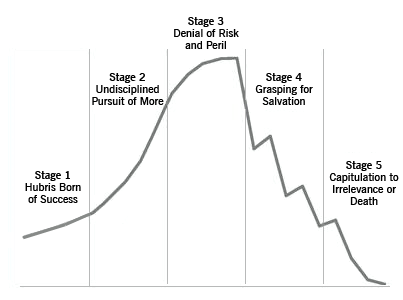
I was involved with an organization that was once so innovative that they were ahead of the curve with desktop apps. However this organization didn’t realize what they had. I spent almost 10 years with this organization and the last 12 months was a text book example of Jim Collins’ “5 Stages of Decline" that he outlines in “How the Mighty Fall”

Stage 1: Hubris born of success
Stage 2: Undisciplined Pursuit for more
Stage 3: Denial of Risk & Peril
Stage 4: Grasping for Salvation
Stage 5: Capitulation to irrelevance or death

So I have first hand experience on the impact poor leadership & inaction can have in uncertain times; and how difficult it can be during disruptive periods when there is so much new information. Collins has this advice during uncertain times;

“Never give in. Be willing to change tactics, but never give up your core purpose. Be willing to kill failed business ideas, even to shutter big operations you’ve been in for a long time, but never give up on the idea of building a great company. Be willing to evolve into an entirely different portfolio of activities, even to the point of zero overlap with what you do today, but never give up on the principles that define your culture. Be willing to embrace the inevitability of creative destruction, but never give up on the discipline to create your own future. Be willing to form alliances with former adversaries, to accept necessary compromise, but never- ever – give up on your core values.
 
The path out of darkness begins with those exasperatingly persistent individuals who are constitutionally incapable of capitulation. Its one thing to suffer a staggering defeat – as will likely happen to every enduring business and social enterprise at some point in its history – its quite another to give up on the values and asperations that make the protracted struggle worthwhile. Failure is not so much a physical state as a state of mind; success is falling down, and getting up one more time, without end.” 

Solution 4) Collaborate
I heard a comment from the World Economic Forum which was something like;

In times of change and uncertainty networkers are needed as much as leaders” because they can draw on the experience of numerous sources to try to solutions, which is in line with Steven Johnson's ideas about "Where Good Ideas Come From"

The level of collaboration that we are seeing from the most successful businesses is staggering, and seems to be a key factor that sets great organizations apart from others.

With regard to education last weeks’ Question Time highlights this issue very well. During the debate about whether or not public education can compete with private education (A point that I believe passionately in and can cite a number of examples – many of which are included in my Culture in FE report... two notable additions I discovered since this report are “Solution Focused Interventions” & “The Pagmalion Effect”) 

David Starkey hit on a key differentiating factor when he highlighted that a key difference between public/private education is that everyone is singing off the same hymn sheet in private education – teachers, parents, administrators all pulling in the same direction. This is not necessarily always the case in other areas.

77685 600 Teachers in 1960 and 2010 cartoons

For example, we see this anytime private education comes under fire, like with charitable status. Schools who are usually in competition with one another come together to stave off any threats to their organisation.

While there is a strong united front in FE through various associations and quangos, I have also seen some frustratingly fragmented goings-ons too.

I could cite a number of examples, but for the purposes of this post, I think the FELTAG responses is good example… so please allow me to reiterate - if you have ever complained about the college IT infrastructure or about politicians not listening to educators or forgetting about FE, then I hope you have responded to the FELTAG consultation?

Solution 5) Ramp Up Experimentation
Our recent EdTech report "Developing Relationships & Delivering Value" highlights how the early adopters are undervalued, despite their contribution being invaluable as "change agents".

I am working on idea that will turn this report into a workable plan and just might lead to better Tech tools AND at a hugely reduced rate (anywhere from 30-50% reduction or, in some cases, free of charge!). The plans for this were drawn up precisely so that experimentation could still be a possibility despite the current budgetary constraints.

However, these plans rely on getting the sectors' views on Technology, so need people involved with FE to take a few moments to complete this survey; Critical Friend & Early Adopter Survey

So far I’ve had a response rate which is on a par with the FELTAG consultation... Indeed I was starting to take things personally until I noticed that FELTAG was facing the same challenges.

Regardless of your position or department at the college, I am keen to hear your views and would be extremely grateful if you could take a moment to fill this survey out

Equally if you are an educator and have your own ideas remember that Ed-Invent are interested in hearing from you.

I’m going to give it another couple of weeks before taking a decision about my current plans and hope people will complete this and share it with colleagues.

While I’m waiting I think I'll head off to Starbucks for a coffee, perhaps I should pitch my ideas to them while I’m there… Just in case.

This post has been so much about the negative consequences or inaction that I almost forgot the best bit - the rewards of proaction... Enjoy! Here's the story about an organisation that Fast Company has named as one of their most innovative organisations;

Thursday, 6 February 2014

Where in #FE is Everyone?

It was Digital Learning Day in the US yesterday and the organisers were encouraging educators to take a pledge to;

"Give every child the opportunity to learn in a robust digital environment everyday, with the goal of success in college and a career. We urge you to make a difference with digital learning in America's schools and take the pledge to support the effective use of technology to improve education for all students"

It is a couple of years since I wrote my Twitter in Further Education report and I am doing some research on #EdChats and conferences at the moment, so decided to download all the Tweets from all the FE hashtags that I could find.

Part of the reason for this is because I have seen, with more and more frequency, people in FE asking for lists of FE people on Twitter, but were finding it tricky to find colleagues... even though its such a pervasive medium now. 

I thought this was a little strange as I had sourced over 2,000 FE related accounts, so decided to explore... and found that the world of Further Education sure does seem to be a little fragmented on Twitter. 

FE Twitter Lists
I pulled together as many FE Twitter accounts as I could find when I was writing my Twitter in FE report and put the following lists together;
I have found that compiling these lists was a good use of time as I can check at a glance what is happening each day in the world of FE.

Not on Twitter yet? Please find these lists on the following spreadsheet – Tech_Stories: FE Twitter Lists.

(NB This is by no means a definitive list and if you’d like your account to be included in any of these lists, please fill out the details on this link – FE Twitter list: New Contact there is also @moodlemckeans - FE & Skills EduTweeters list )

#EdChats
I have continued to explore the world of Twitter in Education over the last 12 months including the use of hashtags and #EdChats.


In January 2013 I noticed that @MrsSarahSimons was trying to establish #ukfechat. As I was "between projects" I offered to use my contacts and sales experience to see if I could help "drum up an FE crowd" ...to find the early adopters to get the session established.

It's a year since I became involved with #ukfechat and was interested to see the extent to which this has been established. I wonder if you can spot the same thing that I did... Here are some stats;

NB The reason I have separated the contributors i.e over 10 Vs under 3 Tweets is because anyone with less than 3 Tweets may have been "replying" to a tweet and are less likely to be a regular member of the hashtag community. For the same reason I have discounted anyone with less than 3 Tweets (All data and stats are included below).

Top Contributors
The most regular contributors for each hashtag include (Number of Tweets in blue text);


UK Vs US Participation
People who follow my account may have noticed (and may even wonder about), my participation in US EdChats when my focus is on UK Further Education. There are 2 reasons for this;

1) I am always on the look out for new ideas that might be useful to FE, and
2) The use of Twitter within the FE Community still appears to be in the early stages

My exploration of the world of Twitter in Education over the last 12 months has given me lots of new ideas. In the world of #EdChats and Hashtags there appears to be a defacto hashtag in just about every area of Education, so people can find out what’s happening with a quick search of the hashtag. 

This includes different areas of education whether by age rage, subject, use of teaching methods/technology or location. In the UK this includes #ukedchat #SLTChat #EdChatie and #Niedchat.

Having a number of hashtags might not be unusual for a community of 400 institutions, 200,000 members of staff and 5 million students may have difference areas they wish to discuss - especially as there are 2,000+ FE based accounts. But with FE having a number of hashtags appears to be some what divisive.

I recall an article doing the rounds in the US last year called "Tweet Thine Enemy" is the FE equivalent "Avoid that Hashtag?"


I like an #FEParty with an Atmosphere
I was never quite sure of what the #FEparty hashtag meant, whether it was FE Weeks dedicated hashtag or if it was an hashtag that was like @Stu_Voice & #Stuvoice in the US. Looking at this data has helped answer this question for me.

The crazy thing is that #ukfechat have looked to include students in their discussions and would have been extremely interested in hearing these students' views and opinions on their education.

Networkers 
On a similar note, something that has been particularly surprising is, given how small a community FE is (and how few people are on Twitter) is that people are not using more than 1 or 2 of these hashtags;


Sector Breakdown
Not only there only appear to be a very small number of people getting involved with any of these Hashtag discussions (133 Accounts using a hashtag 10+ times; 247 using a hashtag 3 times or less), but this is compounded when you look at the type of accounts using them, as there appears to only be 68 people based at an FE College;


So what are my takeaways from this dataset?
  • Further Education on Twitter is a fragmented place, one where people have their preferred hashtag and there is little by way of cross communication;
         If you want to reach college staff who are early adopters, use #ukfechat
         If you want to reach students or FE News providers, use #FeParty
         If you want to reach an FE Supplier, use #furthered
         If you want to reach the wider FE Community... Not sure Twitter is the best medium
  • Most of the work that I am doing is looking at ways that suppliers can engage with educators in a welcome and collaborative manner, and even when I look at the Twitter data from BETT there only appear to be 4-5 FE people (and it was interesting to note that a former Minister for FE posted 4-5 Tweets at the BETT conference; opposed to 1 on any FE Hashtags... despite their being 60+ times he was @Mentioned on #FE hashtags)

    I said in my Tech in FE report how, with just a little co-ordination FE could be a great launchpad for startups, I wonder if the sector will get there.

    That said as someone with a "commercial" background, along with the data I am looking at elsewhere I wonder if my involvement with #ukfechat is a help or a hindrance... after all some 25-30% of Tweets on the #BETT2014 hashtag were from suppliers saying "Look at us... look at us..."
  • The differences in the use of Twitter in the US compared with the UK remains marked, on a day when the US is making pledges to make a difference with digital learning, with so few members of staff at colleges exploring the merits of online communities.

    It makes you wonder what guidance our students are getting, if following the Twitter stream for any particular TV show is to go by, there is cause for concern.

    On the day when a poll by knowthenet finds that over half our young people are using social media, data like this makes you wonder if anywhere near 50% of our educators are teaching digital citizenship, because let's not forget that before you can be a digital teacher, you need to be a digital learner.

    An active member of the FE Community made a suggestion around the same time I published my Twitter in FE report. His suggestion was this; MoodleMcKean - World of Twitter

    Paul I think this is an extremely important area and happy to help make this happen, and can think of a few others that I think would get behind this, particularly as;
  • Any role that I had with #ukfechat is complete. I said I would use the professional persistence from my sales skills to help drum up a crowd, it appears from this data that this has been achieved.

    I'll be contemplating on what role to continue to play in this #ukfechat community... and, indeed the wider FE Community too. As my own report highlights;

    "Persistence is critical to entrepreneurial success, but stubbornness can kill 
    a business"

    Anyone who knows me will testify that I sure have been persistent, and I've tried different ways to engage FE but, after 13 years, I'm getting tired.

    The full dataset that provided these stats can be found on the following link - #FE Hashtag Data