Wednesday, 25 October 2017

Twitter in Scottish Schools - Some Observations & Suggestions


In my last post I included some of the data and resources that I had curated around Twitter in Scottish Schools. This post picks up on this data and includes some observations and suggestions that I hope proves useful to Scottish Schools... whether they are on Twitter, or not!

A long post? Too many links? Poorly structured or badly written? I work very hard on my communications but don't always get it right.

The intention of this post is knowledge transfer, to share what I've learnt from following the practices of Microsoft, Pokemon Go, US Educators the #Cmgr community... all in the hope that it assists people who are doing innovative work in Scottish Education.

I hope people can see past any poor communication (If any) and gets value from some of the information and resources shared below. I've learnt SOOO MUCH from every link that's included below. I hope including them in one place saves educators a little time, just like the ISTE DigCit PLN Pokemon Go report was designed to do.

I've no doubt that the links in this post will be an Acre of Diamonds for anyone who takes the time to explore them all.

I guess a good place to start to get people's attention might be to kick off with an article about how a Social Media campaign helped a school to find a new Head Teacher:
...Before resuming some discussions about the data I've been exploring and curating.

In the Community Management publication CMX, they have articles like their Guide to Getting Started on Community Management and How Do you Lead a Community? The 6 Common Characteristics of Servant Leadership in Communities the advice in these articles includes things like:

"Step 1: is to Listen, listen, and then listen some more. Get the lay of the land so that you know where you’re headed, like the picture in a Legos kit" and “listening without judgement is the first characteristic of a servant leader"

Listening Without Judgement
Listening is what I did in 2015, this is what I did when I explored Scottish Education via the Skypeathon in December 2016... and this is what I've done again over the last few weeks with curating this map and these lists.

Are there schools with 70+ accounts, who have a combined following of 30,000+ on Twitter? Are there local authorities where almost all the schools are on Twitter? There sure are!

Are there schools, departments and educators who have opened accounts in 2015 and appeared to have either deleted the account since then and/or not Tweeted anything for a while? Or are there Local Authorities with a relatively small percentage of schools signed up? Yep, there are!

Do I have an opinion about this one way or the other? Yes I do! And it's this...

I'd be surprised if many educators were given any kind of formal training on social media at Teacher Training College. I also understand the perspective of both the proponents and the detractors... the schools and educators who get a lot out of Twitter, as well as those who have tried micro-blogging but soon quit because they could not see what all the fuss is about.

So any educator who has wondered "Hmm I wonder what this Twitter thing is all about and what it could do to help me in my work" and gave it a go, regardless of the experience and results... good on you for exploring the technology!!

What I DON'T understand, however, is how policy makers and the current Government who (given the success they had with #IndyRef and #GE2015 campaigns on Twitter) know the value of Twitter and the impact it's had on their own job prospects.

But, according to the data, this group don't appear to have done as much as they perhaps could have in education. What data? I hear you ask...

When sourcing school accounts I curated Tweets where people were talking about schools who were not on Twitter.

This Scottish Schools Not on Twitter Storify includes politicians... I wonder how much they did to discuss the benefits of social media during these visits and photo opportunities. (That's not a snarky comment... It's an honest and genuinely curious question).

So educators... good on you for giving it a go. Policy makers/politicians... I don't understand your actions and doubt I ever will.

"This process could be used in many areas of Scottish society. The SNP benefited from the kind of process that major technology companies utilise, so they know it works. When I'll be impressed with the SNP, or any other party, is when they decide to use these principles in other areas, not just politics.

If any politician (from any party) wants to know how to continue to take advantage of this process in politics or, ideally, apply to other areas, especially in education, you know where to find me if you have any questions."  
#GE2015 Why SNP Domination was Inevitable & in #GE2017 & The SNP - How the Mighty Fall

Look for the Bright Spots
Anyway back to educators and this data. When looking at datasets like this, one of the main things I'm looking for is "who are the early adopters and innovators?"... and to assess what stage progress is at? What's the uptake in the community like?

In the case of Twitter in Scottish education in 2017 I was looking for users like Larbert High, St Mungo (Falkirk), Grangemouth High, Fettes College, Stirling High, Bo'ness Academy and Forfar Academy all of whom have a collective following of over 10,000* across all their school accounts.

All of the schools mentioned above have over 30 accounts, as do Graeme High, Gracemount, Wallacestone, Dunbar Grammar, Newbattle High, Lornshill Academy and Carron Primary School.

Equally Falkirk, Midlothian, Inverclyde and Stirling Council have the majority of their schools using this resource... but in other councils less than 25% are.

When half of the schools in Scotland are not using a free resource that's tried, tested and valued by many... surely some questions need to be asked? And a good place to ask those questions would be with those schools who are a little further forward in their exploration of those tools.

NB* As you will see in this post, I know that the number of followers is not the bee all and end all... It's what kind of shape you community is in. It's the shape that gives your community and Twitter experience value.

Stats: League Table Vs A Little Friendly Competition... and "Social Proof"
One of the things that I got a number of enquiries about was the table with the number of schools in each LA and the number of schools on Twitter at the end of the previous post.

Some questioned the number of schools in the LA (Schools with both Primary and Secondary Provision were included in both columns and Independent schools were listed in the LA figures as well as a separate Independent row for private schools... then there's the fact that the data was from 2 years ago), others felt that the stats were a little bit "League table-esque"

Please allow me to state the two main reasons for representing the data in the way that I did:

1) To put social proof to work

"No leader can hope to persuade, regularly and single handedly, all the members of the group. A forceful leader can reasonably expect, however, to persuade some sizable portion of group members. Then the raw information that a substantial number of group members has been convinced can, by itself, convince the rest. Thus the most influential leaders are those who know how to arrange group conditions to allow the principle of social proof to work maximally in their favour" Robert Cialdini

As I've stated in the last few posts, the impact of me phoning and emailing educators would be both annoying to the educator and ineffective compared with organising the data in a way that "Arranged group conditions to put social proof to work" and show how popular a resource is amongst colleagues and peers.

Google, Apple, Microsoft, Twitter, Minecraft, Pokemon Go don't makes these pointless calls but seem to do OK when it comes to engaging educators... What is it that they do differently?

Check Out the Bottom Tweet! "I'm a Salesman... Get me out of here!"
It was during this session the idea of #StartupEduChat came to me
They collaborate with early users and iterate their way to "Product Market Fit" before scaling...when they scale it's word of mouth recommendation that helps them gain traction.

The significance of joining #EdTechChat in the first 6 weeks of the chat and, in particular, this exchange with Susan Bearden, cannot be underestimated regarding the ideas in this post and my professional development.

Social Proof and highlighting the "Bright spots," the fact that four Local Authorities have most schools using something *Just Might* encourage others to take a closer look, if the data is set out in a compelling enough way.

In sales? Reskill! Cold calling is dead! Work in a call centre? Reskill! You'll probably be replaced by a bot.

2) A Little Friendly Competition
I did similar research to this in UK Further Education in 2011 and produced this Twitter in FE Report.

At the time an article about how Texas A&M and Louisiana State University's sports rivalry had spilled over into social media... with students getting competitive to see who could get the most followers (See Page 10 of the report).

More recently, and a more local example, is (Again) Microsoft and their "Three Nation's Challenge" during the Skypeathon, which seemed to have an impact as 2 educators went 36,000 virtual miles in 2015... but 15 educators went 150,000 miles in 2016.


So, while some of the stats may appear to look a little "League Table-ish" this is not the case. The rationale was to see if "social proof" and a little competition (Whether between LAs, schools within a LA or different departments within a school) might help to "Nudge the Needle" forward a little.


The points above have certainly been in mind when trying to apply the fantastic ideas from Jisc's
Tweeting... Stats, Followers and The Biggest Lesson I've Learnt from Being on Social Media
People are coming to me to ask questions like "what does a good school social media account look like then?" 

The answer to this is both I don't know... and it depends. 

I don't know because I'm not an educator, I've never worked in a school so would be hesitant about telling others how to do their job in an area I've never worked in. 

It depends? It depends... on the reason for being on social media. 

For example, if the account is to keep parents informed of the classes' activity... then a protected account with a class of 30 which has a following of 30-60 people who are all parents or guardians with hundreds (or event thousands) of Tweets about class activities... and the communication leads to greater parental involvement and engagement, then that is one massively successful account!!

If the account has been created for an educator to learn from other educators but (For whatever reason) would rather not Tweet much themselves, follows lots of Education accounts and thought leaders, but don't have many followers and/or Tweet infrequently but get a lot of PD and ideas that help in the classroom, then that's a successful account too.

Equally, if you think that having 5,000, 10,000 or 15,000 followers and you share one way broadcasts without really connecting with people is a successful account... You could not be more wrong! 

(Think the way most MPs use SM and you'll get the idea. Notable exceptions, in my experience, being Mike Russell and Linda Fabiani. Epic fails include every constituent MP/MSP since I've been on Twitter).

I had been on Twitter for a few years before watching one of THE MOST influential videos that changed the way I use social media and connect with people.

I know that Community Management isn't all that well known as a career in Scotland (Partly because there are few jobs to be had here!! *Sigh*), but experts in the field like Tim MacDonald (@Tamcdonald) and Richard Millington (@RichMillington) highlight that you can only have a close personal relationship with 15-60 people at any one time.

Companies like Yammer (This is the Community Playbook I refer to the most often for ideas), LinkedIn, Scoopit and LI Paper have grown using tactics like the one's in this #Cmgrhangout on "Scaling Personal Connections" a *Must Watch* video!

Image result for cmgrhangout scaling personal connections

Regardless of the sector you work in or the reasons for being on social media, there's a lot that people can learn from this video... I certainly did!

Another fantastic resource is Kelly Hungerford's Community First: Building Brand Loyalty and Word of Mouth post

Community Management (#Cmgr) in Education
Need more some education examples of these same ideas and principles?

A Community Management Resource that Educators will be familiar with is Michelle Cordy's 2016 ISTE key note. 

I learned a lot from a book about one of the first online communities called "The Well" by Kate Hefner (See also see The Epic Saga of the Well... Even if you don't have time to read all of it check out the sense of belonging that members like Tom Mandell felt here. I also see the online chat/offline connections here being played out in education with Twitter Chats -> Edcamps). This book was recommended by #Cmgrs.

Howard Rheingold (@hrheingold) was a member of this group and who mentored Michelle... Because "That's how it works"...you'll need to watch this video to get that reference I'm afraid!! Go on click the link...

The shape matters...
In my Edchat Resource Plan I included Marc Smith's research about how political conversations on Twitter are polarised and don't talk to one another. 

During a Mrc's "6 Degrees of Seperation #Cmgrhnagout," after showing the political divisions he then looks at the shape of #Cmgr Community and said: 

"Oh wow! The #Cmgr community don't hate each other... it's a collaborative network"**. 

For more on the different shapes and connections of communities on Twitter:
To what extent are the divisive, angry and polarised crowds putting schools and educators off checking out micro-blogging? What? It's policy makers who say

"We need to do more about online abuse"

That are hampering progress in Education? How dare I make such a suggestion when they model #DigCit so well!

Well let's make sure that the "unconnected educators" know that! Sure, angry political discussions do exist on Twitter, and it's something that policy makers don't seem to discourage too much... Let's be honest and say "Sure! There will be tricky situations with student and parent engagement from time to time"

But let's also tell them about (and model) the valuable connections that can also be made on Twitter... And that more experiences people can help out with those experiences that are new for all of us.

...Build Diamond Networks
If anyone asks me about ambassador programs in education my advice is always 

"Go check out Microsoft's MIE Expert program" 

They are a very good example to explore, I have been since the first Showcase School "The School of the Future" It's mentioned in my EdTech report (Written in 2012)... This network is thriving right on Scottish educations' doorstep today! (See the Microsoft section at the end of this post).

**NB If anyone likes anything in this post, it simply WOULD NOT be here is if was not for the fact that the shape of the #Cmgr community is a real Diamond! And I'm talking the kind of Diamond that Franco Rodriguez steals from the Smithsonian in Spy Quest latest book "The Cursed Diamond"... They've certainly given me reason to Hope! 53 23 42 15 22 - 31 34 32 - 42 13 44 15 53 - 54 34 15 44 35 - 41 34 55 - 13 54 45 54 15 13 - 25 44 - 23 34 33 44 - 42 13 44 15 53 - 11 54 42 25 34 15 11.

Thank you to each and every member of the #Cmgr community who's helped me to reskill from sales to community management!

Mr Microsoft... Uncle Oracle... 
And for anyone who knows me and/or follows my blog... Words escape me when it comes to James Stanbridge (@Stanbridge):
  • He saw the value in my ideas when no one else did. James, what's happening now is what I was talking about in March 2015. Thank you for believing in me and my ideas!!
  • His intervention made the UK Digital Citizenship Summit possible!

    When DWP sanctioned me because they felt that what I was doing to get work in Community Management for a company that was billed as the "Google for Education" (See "Declara could very well become the 'Google of Learning")... Wasn't a proper job search

     "A blog post is not a job search" My 'Work Coach' Kathleen at Rutherglen Job Center would regularly tell me.... Stupid DWP with their Jobsworth Us Vs them mentality. Complete and utter idiots... That's not so much "IMHO" but more "in me and my family's rather painful experiences!"

    If these are the practices across Scotland then please do feel free to ask for my opinion of  DYW regarding the Digital/Sales/Marketing advice that's given.

    The thing that got me sanctioned also just happened to lead to me working with Declara... and was as per the recommendations in this CMX's article: Why you Should Hire Employees from your Community
  • James was instrumental in helping me secure work in Community management with this hot shot Silicon Valley startup. 

A Couple of 5 min Favours...

THANK YOU James! James is now with Oracle and I hope people in my PLN will do all they can to support him in his work. Please follow @Stanbridge @JAbel_Oracle and @Caz_Apsey... and ask them about their Bloodhound/Oracle STEM Education Ambassador initiative


When working at Declara the quote at the bottom of CEO, Ramona Pierson's, email was Alan Turing's 

“Sometimes it is the people no one can imagine anything of who do the things no one can imagine.”

Seeing that message in someone's emails, especially after reaching a goal that you'd set yourself 6 years earlier (2010:"Work at one of "Big Three - Google, Microsfot, Apple - Or a Hot Shot Silicon Valley startup up was on the "To Do list")...seeing that message on a regular basis has quite an affect I can tell you!

The Pokemon Go report that Declara and the ISTE DigCitPLN Collaborated on was to assist California with their #GoOpen program "Collaboration in Common." Almost 10% of my followers on Twitter are in sunny CA...CA Educators please do what you can to support my friends and former colleagues at Declara to build on your Diamond newtorks.

Here's my Community Management Resources Collection on Declara... all my fav #Cmgr articles in one place. (Yes there are more than the ones in this post. Lol)

Some Good Practice  
While I've not explored the content of almost 5,000 Scottish Edu Twitter accounts, there are a few things that schools, departments and educators might want to consider doing.

1) Create Twitter Lists
Twitter lists are a great way for students, staff and parents to see which members of staff and departments are on Twitter. School like St Matthews Academy, St Mungos and Wallacestone Primary all have staff Twitter lists.

As well as being able to find accounts easily with a Twitter list, another great thing is that, once it's set up, you can scroll through tweets from all the schools' accounts quickly, easily... and all in one place.

Wanna give it a try? If you go to https://twitter.com/EdTechStories/lists you will be able to see all the Tweets for a particular year group/subject or local authority list to see what people in your subject/year group and/or region are tweeting about.

If you want to see what the Digital Leaders in Scottish Education are saying then you can check out what the schools who have registered for the Digital Schools Award on this list: Digital Schools Award List 

If you are looking for some people who have an interest in Digital Citizenship then here's a list of people who pitched in and helped out with the UK Digital Citizenship Summit 

I have over 500 accounts to add the curated resources as people have let me know which accounts are missing (which helps demonstrate the value of the Aggregate then Curate article above).

2) Account Profiles
Something else that has an impact when there are multiple accounts is when the photos include the school logo and brand.

There are a number of accounts I've explored that don't have any text in the bio/profile at all. With the ones that do, I've found it extremely useful when the School Name or (Even better) the School's Main Twitter username is included in the profile.


I hope that the school and departmental lists I've put together help to give people some ideas for creating and/or updating their profiles... I wonder if anyone can beat one of the faviourite ones I've seen to date. 


"Where everyone counts" Love it! Such impressive word play, and from a Maths department too... Who'd have thunked it. Lol ;)

Starting Out
I created a new account so that I had an account that was more focused on Scottish Education with regard to who I follow, so all the Twitter lists were relevant to Scottish education as well as the content of the Tweets. 

I also wanted to remind myself how tough it was to get the account started. After following over 4,000 accounts and sending 100 Tweets the account only has 20 followers.

If I didn't appreciate the value of micro-blogging, I just might be tempted to delete the account or just leave it dormant... Twitter sure can be tough when your starting out!!

In 2015 I put this Scottish Schools Adoption of Twitter document together. With around 7-800 schools on Twitter I can see why there were (and possibly still are) some dormant accounts, the "Network Effects" were not the same as they are now.


Dormant Account? ...Dust it Down & Try Again!
Are you one of the people who gave Twitter a try... opened an account, didn't see what all the fuss was about and just left it? Can I suggest that you dust the account down and give it another go?

Why listen to me? Wouldn't expect you to... here's what I suggest you do:

1) Click on this link: Scottish Schools on Twitter 2017
2) Find a School that has multiple accounts and click on the pin on the map (Or on the list)
3) Look at the "2015 Twitter Accounts" field at the bottom of the entry and/or check the 2015 Map
4) Look at how many more accounts these schools have today
5) Ask yourself... "Would my colleagues have opened this many more accounts in the last 2 years if they were not getting value from using this Twitter thingy?"
6) Follow them on Twitter and then Tweet out "I'd love to learn about how you use Twitter" ... Because that's how it works, right Michelle? Lol ;). Or you could go all "old school" and email/phone them.

If this is a step too far then another option might be to explore Yammer, which is a Microsoft application that is available on Glow, and is another way that students and classes can connect without the content being in public. As far as I am aware, has good uptake amongst Scottish educators.

Twitter Advocate... Helping the Newbies
Given that the "network effects" are now there, if people who were proponents and advocates of Twitter were to follow the "newbies" in any given geographic region and/or subject area those people would have a good number of followers with similar interests.

This would then make the "Feedback Loops" positive as the new teachers to twitter (#NT2T) would find like minded people quicker... and would soon be telling their colleagues of the benefits and then you've got some real momentum going on. 

The more people you know, the more value you get from it, the more frequent the visits and more time you spend on each visit  = real momentum!

Tech Does Not Roll Out in a Linear Fashion
Something that I've been exploring ever since I wrote my EdTech Report in 2012 is the way that technology gets adopted and to highlight ideas like Geoffrey Moore's Technology Adoption Cycle.

In 2015 I found 800 Schools with an account for the school, two years later this has almost doubled and 50% of Scottish Schools now have a presence. 

The Customer Profile for the groups in the image below are quite different, so the approach to engage each group needs to be different too.

Even in schools where there are a large number of advocates it's still not everyone who is Tweeting (But BOY is @LarbertHigh close! Just ask their S1 Digital Leadership team. 122 accounts now I think).

Having an understanding of these ideas and principles could speed up the way technology in general is adopted (Not just Twitter) at a macro and micro level.


Early Adopters
In my previous post I acknowledged some of the early adopters that I had connected with on my travels in Scottish Education (Bob Baldie, Ian Stuart, Malcolm Wilson to name a few) and I could very clearly see the role they played with encouraging their colleagues to check this particular platform out.

THAT is why I have acknowledged their time and efforts in the blog post, and why the stats have been represented in the way that they have been... It's not been to say "Oh look at them aren't they great!" (But, for the record, I do believe that they are!). 

From my own work and involvement with some projects, I know that the early adopters are the people who get the party started, but before long you can't even see them in the crowd because everyone is doing it... But it's those early users who got the party started ;)

Image result for geoffrey moore leaderships lessons from dancing guy

Technology isn't a silver bullet in education, it never was and never will be... HOWEVER, you sure as heck can use technology as a way of creating the culture that I believe is needed and would make a big difference with things like the Attainment Gap and Developing the Youth Workforce... and would empower educators in the way that the politicians say they want to... whether they mean what they say is another thing entirely ;)

Feeling Adventurous... Skypeathon?
If you do dust down your old Twitter account and find it to be a positive experience then why not connect with other classes on the 28-29th November when the Skypeathon is on?

I'd have loved to have heard from some of the experts on some of the organisation who run virtual field trips when I was at school... and I'd love for my kids to be on Skype with these experts too.


The Microsoft in the Room
Anyone who follows my ramblings will know that I see tech companies doing more for Ed reform than politicians (See Pokemon Go... Tech Vs Policy Maker Results.

...*Waves* to @GoutcherD and his "Ingress for Kids"AR  @SpyQuest game, I'm telling you... it's gonna be big!! And I guess Biz Stone was right too, I would LOVE to these two videos updated by being edited and mashed up together.

There's an elephant in the room regarding what policy makers are doing, and that elephant is the fact that, if you look at the data... It's Microsoft that's responsible for a lot of the things that are going on, not the politicians (MIE Experts, MEC, Yammer, Skypeathon, Digital Schools Award, Bloodhound/Race for the Line).

And what is it that Microsoft appears to have done to get to this stage? Just like my EdTech report highlights, where the aim was to explore what the major tech companies do differently, they do indeed appear to have "Developed Relationships and Delivered Value" in Scottish Education - at a macro level by work on Glow, Scottish Educators intranet, and at the grassroots level by empowering educators.

And what's of the criteria for being a Showcase School? That at least two educators are working towards MIE Expert status (Good luck with your application @TolleyA!) ... This provides a nice example at the school level in education the extract of Google Employee #59, Doug Edwards, in "I'm Feeling Lucky" (Which Doug kindly allowed me to include in my EdTech report (P36):

"Two smart guys working on complex technical problems, it turns out, can accomplish a hell of a lot"
Doug Edwards Google Employ #59

There will be some Microsoft Roadshows at a number of Scottish schools in November... why not sign up to go along and assess for yourself if there is anything in this idea: Microsoft Education Roadshows

It might be worth highlighting a couple of points here:

1) I have no affiliation with Microsoft in any way shape or form... But it was a Microsoft Exec who encouraged me to get onto Social Media in 2010 telling me that "It comes with the job today"
.
2) Wondering something along the lines of "Ah but Microsoft only do this to shift their products... it's just marketing and PR?"

Go have a conversation with an MIE Expert or two, or a Showcase School and ask them if that's what their experiences have been... or if, as my EdTech report highlights, it's been a partnership where ideas are co-created and collaborated on?

The Last Word re: Twitter in Edu
I'll leave the last word on this post with the best possible source I can think of... Here's @ElliePrimary1 and @katrinakennett post detailing

  7 Reasoon Why Teachers Should Tweet

What is an #Edcafe?


Because, as Michelle and ISTE PLN leads would tell you, that's how it works.

Links 
Here's a list of some of the links included in this post that I learnt from people in my network. Random articles in a post that's way too long and rambling... Or Learning from a Diamond Network? I'll let you Decide...
Other reports that I've collaborated on with other thought leaders and industry experts can be found at Tech Stories - Research

Monday, 23 October 2017

Scottish Schools on Twitter 2017


In 2015 at the Scottish Learning Festival there were calls for Scottish Education to collaborate more. Through engaging and connecting with US educators I felt this was something I could perhaps help with.

One of the first things I did was to do some "Social Listening" by exploring how many Scottish Schools were on Twitter. As you can see from this link I found there 842 schools microblogging at the time.

In the last few months I have:
  • Followed the conversation and caught up with some people at the 2017 Scottish Learning Festival
  • Explored the number of schools who have been involved with the Bloodhound SSC project
  • Seen the impressive results Spy Quest author David Goutcher has had with engaging Scottish schools. 
When you look at the correlation between the use of Twitter in 2015 with some of these projects I thought I'd revisit and update the work I'd done regarding Scottish Schools on Twitter.

Top Line Stats and About the Data
I have curated information on over 4,900 accounts, this includes the schools' main Twitter account, departmental accounts as well as educator accounts.

The search for each school having a Twitter account has been a thorough one and I hope most have been added to our resources, but there most definitely will be a lot of departmental and staff accounts not included.

I did not have the time to look through the followers of 1,300 school accounts, areas I did explore included:
  • The 39 schools who had 10 Twitter accounts or more in 2015 to see if and how micro-blogging has grown at the schools who were already Tweeting about school activities.
  • Schools who had been awarded Digital Schools Award Status
  • Schools at Local Authorities where the uptake of Twitter in education was high in 2015 & 2017

If you click on a school that has a Digital Schools Award you will see a link to the Digital Schools website as well as an article in the "Twitter/SM Policy & Digital News" field.

The stats at the end of this post includes 1,465 School accounts, 300 Head Teacher/Deputy Head accounts, 1,885 Departments and 807 staff accounts. These accounts can also be found in 3 of the lists I curate:
These large lists are also included in Departmental Lists (By subject and year group) and geographic lists by Local Authority via this link: EdTechStories Twitter Lists

You will also find some useful lists on David Goutcher's account
Aggregate then Curate & "Social Selling"
It would be a challenge to have a complete directory of Scottish Edu accounts in the time that I've had to pull this together but two things that I hope this follow up to the 2015 research assists with are to demonstrate:
  • The value of the ideas from JISC's Aggregate then Curate: How Digital Champions Nurture Online Content, the ideas in this post have been consistent with some of the projects I've worked on.
  • That technology and new ideas do not develop or gain traction in a linear way. There's been a bit of a jump from 800 Schools with accounts in 2015 to almost double that in 2017.
And, just like my questions with Edcamps and Eventbrite in May, it's worth asking who's "Selling" this to educators? The answer of course is no one at Twitter and everyone in the community who is an advocate.

From the stats I can see that, just like two years ago, Twitter is a positive experience for some and an underwhelming one for others (is is apparent from the deleted, dormant or infrequently used accounts).

In a follow up post I will be encouraging people who opened an account but hasn't done much with it, to dust it down as the conditions appear a little different.

In the mean time, as I am not able to spend the time that I'd like to exploring this it would be good to see if the ideas from Aggregate then Curate is possible here and ask people to either:


Many thanks to Andrew Bailey (@andrewkbailey13), Kevin Kellman (@KelmanKevin) and David Miller (@DavidMiller_UK) who have already helped out with this but sending details of accounts for schools in Angus, Stirling and at Kelvinside Academy.

Since publishing this post a few hours ago 107 new accounts have been sourced and will be added to all the existing resources below.

I hope the Scottish Education community will continue to add to what I've curated so far. Before sharing the map and all the stats I thought a bit of background would help... I'd I like to acknowledge the time and efforts of a few people.

A Little bit of Background... and A LOT! Of Acknowledgement
Much of the work that I'm doing has it's basis in the EdTech Report that I wrote in 2013 "Developing Relationships and Delivering Value."

Any work that I've done in Scottish education simply would not be possible without the time, encouragement and work of a few people. This includes (In chronological order):

James Stanbridge (@Stanbridge)
If anyone likes the work that I'm doing at the moment I'm not sure if I'd be focusing on it today if it wasn't for James Stanbridge.

In March 2015 we had a Skype call where I detailed what I was working on, and how I felt it could assist with how ideas in education gain traction.

James was the first (And, at times, only!) person to see the value in these ideas... and that has made all the difference!!

James also provided financial support that allowed the UK Digital Citizenship Summit to happen, and was instrumental in helping secure my first paid role in Community Management... Empowering, confidence building stuff! That's a lot of stuff to be grateful for! TY James!

That, along with the fact that my 16 year old son loves the idea of what the Oracle STEM Ambassadors could bring to his school, is the reason I have been (And will be) supportive of Oracle Academy's work.

Interested in Developing the Youth Workforce? Well check these links out out:
Bob Baldie (@BobBaldie)
In 2015 the first post that I wrote regarding Scottish Education questioned the approach that was being taken (See DYW & Circle the Schools).

Why write in this way if you're trying to "Win friends and influence people?"

The reason is simple, to assess if the culture is right. After writing the post I received a message from an Education Scotland account that Bob had access to and he felt some of the ideas and comments had value...

It may only have been a quick conversation 2 years ago, but without this engagement I may not have explored much of the ideas and research below.

So thank you Mr Baldie!
"Community builders who are usually so behind the scenes that their work gets “absorbed into the greater narrative' of the community and forgotten" CMX How to Lead a Community

This is a comment that I feel applies to the efforts of Ian Stuart and Malcolm Wilson and their colleagues.

Ian Stuart (@IanStuart66)
Upon completion of the Twitter data in 2015 I was invited to join some of the discussions around the Digital Learning Scotland consultation by Ian Stuart, an invitation that was as welcome as it was surprising.

Microsoft is getting a lot of love in Scottish Education, this is something that Ian appears to have helped with a great deal as Islay High School was Scotland's first Showcase school and the way he appears to have supported and encouraged many an MIE Expert.

I enjoyed the group conversations that Ian facilitated and enjoy hearing his ideas in when catching up over a coffee.

Ian is now with No Tosh and I cannot recommend anyone with an interest in organisational culture to get in touch with him enough!

Malcolm Wilson (@claganach)& Falkirk Council
In 2015 the data that I explored kept screaming out "There is something special going on at Falkirk Council," following up on this work and there is absolutely nothing that I've seen that changes this view.

Two years ago I wrote Google Culture Meets Apple Hustle at a Local Authority & Digital Learning - PD with Larbert High. When I check in on Twitter in 2017, I see nothing to change these views.

All Falkirk Schools
Now appear to be on Twitter

Larbert High 
Has a total of 67 accounts and a collective following of 36,000, this is closely followed by

St Mungos 
With 65 accounts and over 18,000 followers (And a rather helpful Twitter list), a Microsoft Showcase School and Teacher of the Year.

Wallacestone Primary School 35 Accounts and another helpful Twitter list

CarronPrimary, GrangemouthHS, DeanburnPS, HeadofMuirPS, GHSfalkirk, carmuirsprimary, WestquarterPrim, VictoriaPrimSch, bantaskinps, Kinneil_PS, BowhousePS, BraesHigh, BonnybridgePS

All have 10+ Twitter accounts too

I appreciate that this is the work of an entire Local Authority and all the fantastic learning and CPD that takes place, but someone sets the tone of the culture here.

As far as Twitter is concerned... all the data and blog posts I've explored, it all suggests that Malcolm plays a significant role here.

If you highlight or suggest this to him he'll simply credit other colleagues in the Local Authority and the staff at his schools for the results.

As someone who knows the importance of culture and that a lot of the hustle goes unnoticed behind the scenes... I can spot a Caped Crusader working incognito when I see one. Kudos to you!


Bloodhound SSC
In July James told me that something was happening at Bloodhound. I asked how many Schools Bloodhound had visited and he wasn't sure at that point, so I decided to see what the data told me.


I curated a number resources regarding Bloodhound's fantastic work in Education to date, I mapped over 1,200 schools and added any articles and you tube videos that I could find. Check out the BBC School Report and other content Truro High School produced following the visit (Entry 981)


...And what did I find in Scotland? I found what I thought I'd find.

Exploring Twitter is not the bee all and end all of technology in education, far from it! However... it can be a good indication of a number of things.

For example the early adopters on Twitter may well be the early adopters with other things. It was no surprise to me to see the schools who participated in Bloodhound's "Race for the Line" also featured prominently in the stats that I curated for Twitter in 2015.

David Goutcher (@GoutcherD) & Spy Quest (@SpyQuest)
I first met David earlier this summer where we connected as a result of following up on work I'd done around Pokemon Go in Education in July/August 2016.

When we first met the topic of conversation was discussing my follow up to Pokemon Go and to assess if and how what I was doing might be able to assist him in his work.

Then my youngest son experienced David's work and we became fans (Three of my recent posts detail our Spy Quest experiences).

As I shifted focus to Bloodhound and Twitter two interesting things happened:

1) David shared some of the Twitter lists that he'd curated before he visited a school, and
2) I agreed to help pull together a map with the number of School visits that Spy Quest had made
3) Then the Falkirk Story Festival happened.

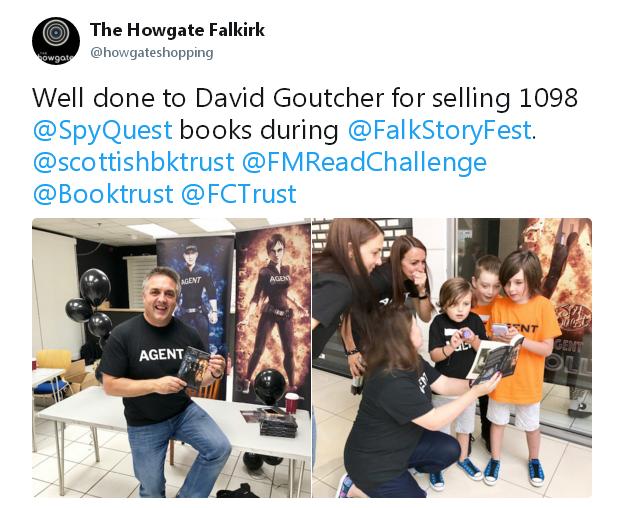
David did a tour of Falkirk Schools prior to the event and on the day the Howgate Shopping Centre was over run with kids dragging their parents to play the game and buy 1,089 books (That's after the being available at the school during the visits too!). Check this out!


Seeing the results from this event is the reason for exploring Twitter in Scottish Schools in 2017.

Culture! Culture! Culture!Did you spot it? Did you spot the common trait? First I think I could make a pretty good argument about how all these things are petty well connected and secondly, from what I've seen these people take great care in cultivating the culture within their respective organisations.

Is this being dismissive of any of the great work that many, many people are doing elsewhere? NO! It is not!
It is detailing how and why I've taken the time to do this work, who I've connected with and acknowledge the contribution that they have made? It sure is!!

How much of this work would be here if it wasn't for all Ian's efforts to become the First Microsoft Showcase School in Islay back in the day (Whenever that was?), how much of what Jacqui Campbell and her staff is doing with technology at St Mungo's School is inspiring and empowering educators within her school, other educators in the Local Authority ...and further afield?

I've no idea is the answer, I've never spoken to her. I only stop in and check Scottish Education out once a year following the Scottish Learning festival to see if the cultural conditions are good for change... and I ALWAYS go looking for the bright spots... who's doing really well in this area and what can we learn from what they're doing. More on this in my next post.

In the mean time, as I highlighted in my earlier post, where I reflect on The Scottish learning Festival and the Power of Data...

"Educators are not interested in the sales calls or emails that I used to send. What educators do care about and rate is what their colleagues have to say about a project and word of mouth referrals.

So instead of trying t be heard or taking time making random calls, I choose to spend my time curating information that people don't always have the time to do"

I've taken a large data and have pulled it together in a way that it saves educators a little time and helps people to connect via micro-blogging. I hope it helps...

A Quick 5 Min Favour... 
Before sharing the data that's taken a few weeks to curate. I would be extremely grateful if people could help to add to this dataset by either adding School, department or educator accounts that are missing and/or to share any social media policies and/or good news articles that you are aware of.

Please see the following link for more details: Scottish Schools on Twitter Survey

Zeemaps (Click on the School pin for more details)
Scottish Schools on Twitter 2015
Scottish Schools on Twitter 2017


Local Authority Stats Summary*
To access details of all 4,000+ accounts please see this Google Doc: Scottish Schools on Twitter 2017

*NB The 44 Schools have been awarded and over 500 have registered for Digital Schools in Scotland. The 32 Schools Awarded and 312 Registered in the table above refers to the schools awarded and registered who have a Twitter account.

Monday, 25 September 2017

Spy Quest Mission - Part III (JAM Busters)

Related image
I've written two posts that detail the meetings I've had with Spy Quest (@SpyQuest) author David Goutcher (@GoutcherD) as well as my youngest child's experiences with his books.

Spy Quest Mission - Part I
Spy Quest Mission - Part II (This time it's Personal)

As a result of being one of Theresa May's "JAMs" (Or whatever you call people who are a rung - or two! - below this stage) we were not able to make it to our first ever Spy Quest training mission at Falkirk Story Festival (@FalkStoryFest)on Sunday.


As we missed this event I thought I'd spend the time we'd have spent there detailing how and why I feel Spy Quest is not only very well placed to assist the unfortunate "JAM" demographic but also highlight our experience to show why we feel David's work and AR game really is going to be "Ingress for Kids."

As a family we're not doing so great. We were, at one point, one of the "Young Aspirational" families that David Cameron was championing for when he was looking to be elected. Unfortunately, slowly (But very surely!) we've slide back down the socio-economic demographic.

I know that some people have felt that I've been a little critical in my blog any time good opportunities for change fade... It's perhaps worth noting that I can be just a critical of my own efforts.

For example, I'm painfully aware of how I've changed as a parent. We've gone from a household where using words like "Stupid" and "Bored" would see you being sent to thinking time... To, erm... well, let's just leave it at "there's a fair bit of stress!"

As always, we try to make these experiences work for us as best we can. It's by no means ideal but we are fortunate all the same to have examples from people like Stan Lee who highlights in his autobiography how stressed his dad was due to money worries, that "He would look in the paper every day for jobs that didn't exist" talking about his time growing up during the Great Depression.

Here's what I was Tweeting about when I should have been on the way to Falkirk
Stan Lee made this work for him by using his imagination (Oh and his Local Library... A place where Spy Quest clubs are ran!!)


We're obviously by no means unique in this situation. Just this week I read that kids born around 2000/01 are more prone to depression... Well I guess spending half your life under austerity is gonna have an impact, isn't it?!

Scottish Learning Festival
The Scottish Learning Festival was on last week and I switched Twitter onto that channel at the start of the first day. I quickly found that I had one of  two choices when John Swinney came on...

1) Get snarky or
2) Switch the channel off.

I stopped following the feed.

I simply didn't recognise the "Let's close the attainment gap" and "Scotland is a great place to grow up" that he was talking about... I can't say that Scotland was the greatest place for me when I was a kid (But obviously I acknowledge that there are A LOT worse places to live!) but I also can't say that my kids would be jumping out their seats in support and agreement if they were in the audience when this was said.

For example, as hard as we tried (And we went round ALL the Glasgow companies he thought he'd like to work at)... We couldn't find Work Experience for him. Not exactly what I'd call "Developing the Youth Workforce"


I'm sure it is indeed a different Scotland that Mr Swinney and his colleagues at Holyrood, including the #FortheMany-wannabe-Labour-Leaders-who-have-multiple-jobs/business-interests-and-lavish-expense-accounts and send their kids to private schools...But that's not our Scotland. We're in a JAM! And it's not much fun!!

Compare this with Apple where new hires are given an Apple PC to play around with for 3 months. If they were able to demonstrate that they had used it they got to keep it. If they couldn't their trial period was not continued... The argument being how can you work on and improve on a product if you don't use it yourself?

Terman Study - Family Background
As I highlight in my last post, we tell our kids that

"They can do anything they set their mind to" 

And I do believe that (As long as they prepare and do their best). We try to model this and I'll do all that I can to help them find their place in the world.

Even in amongst all our troubles our young Agent who missed the Spy Quest event just received a letter inviting him to join Equity because he's acted with people like Ewan McGregor, 7 years old and he's been in the same film as Obi Wan?!

Being a good Agent. Blending into the background and walking so he doesn't draw attention to himself. Lol
Nevertheless it can be a challenge when you have limited resources. It's painful to see all the extra-curricular activities drop off because of a lack of resources.

As with everything we "Hope for the best... but plan for the worst" In the hope for the best camp, everything will turn out OK. In the "Plan for the worst" category Lewis Terman's work has been playing on my mind.

Terman did a longitudinal study on children with high IQs in the 1920s, check out the results (And reason) between the group A and group C kids:

"What was the difference between the A’s and C’s? Terman ran through every conceivable explanation...in the end, only one thing mattered: family background. The A’s overwhelmingly came from the middle and upper class. Their homes were filled with books. Half the fathers of the A group had a college degree or beyond, and this at a time when a university education was a rarity. The Cs on the other hand, were from the other side of the tracks. Almost a third of them had a parent who had dropped out of school before the eighth grade. 

 At one point, Terman had field workers go and visit everyone from the A and C groups and rate their personalities and manner. What they found is everything you would expect to find if you were comparing children raised in an atmosphere of concerted cultivation with children raised in an atmosphere of natural growth. The A’s were judged to be much more alert, poised, attractive, and well dressed. In fact, the scores on those four dimensions are so different as to make you think you are looking at two different species of humans. You aren’t of course. You’re simply seeing the difference between those schooled by their families to present their best face to the world, and those denied that experience. 

 The Terman results are deeply distressing. Let’s not forget how highly gifted the C group was. If you had met them at five or six year of age, you would have been overwhelmed by their curiosity and mental agility and sparkle. They were outliers. The plain truth of the Terman study, however, is that in the end almost none of the genius children from the lowest social and economic class ended up making a name for themselves".

This extract is from Malcom's Gladwell's book "Blink" where he argues that it doesn't matter what you try to do for your kids when they are born... it's who you are before they were born that makes the difference. Theodore Dalyrymple tells it like it is regarding the attainment gap if you are unfortunate enough to be "Lost in the Ghetto"

Little has changed since Dickensian times on this front so you'll need to forgive me for not jumping up and down with joy at a politician giving a speech telling me how great his plan is working out.
   
Tech Cos Vs Policy Makers
Pretty depressing stuff so far, right? Fortunately, we're also optimistic and we also read the writings of people like James Allen:

"Your circumstances may be uncongenial, but they shall not long remain so if you but perceive an Ideal and strive to reach it. You cannot travel within and stand still without. Here is a youth hard pressed by poverty and labor; confined long hours in an unhealthy workshop; unschooled, and lacking all the arts of refinement. But he dreams of better things; he thinks of intelligence, of refinement, of grace and beauty. He conceives of, mentally builds up, an ideal condition of life; the vision of a wider liberty and a larger scope takes possession of him; unrest urges him to action, and he utilizes all his spare time and means, small though they are, to the development of his latent powers and resources. Very soon so altered has his mind become that the workshop can no longer hold him. It has become so out of harmony with his mentality that it falls out of his life as a garment is cast aside, and, with the growth of opportunities, which fit the scope of his expanding powers, he passes out of it forever. Years later we see this youth as a full-grown man. We find him a master of certain forces of the mind, which he wields with worldwide influence and almost unequaled power. In his hands he holds the cords of gigantic responsibilities; he speaks, and lo, lives are changed; men and women hang upon his words and remold their characters, and, sun-like, he becomes the fixed and luminous center round which innumerable destinies revolve. He has realized the Vision of his youth. He has become one with his Ideal"

Regarding this more positive outlook it's both interesting and surprising the people I am in contact with discussing my ideas.

For a rather long time I've felt that the biggest change is not going to come from policy makers but from the change agents at tech companies collaborating with innovative educators... before it'll come from politicians.

This is something that I highlighted in my "Pokemon Go... Tech Vs Policy Maker Results" post last July


Need an example of this from a real life JAM? The rest of this post details how and why Spy Quest turned a mundane trip with a stressed out dad into a a Pokemon Go/Ingress-type, memorable, #attainmentgap busting (And fun!) mission.

Spy Quest - JAM Busters

It's Saturday, time for one of the few extra curricular activities that we can afford.

The Government has screwed up some of the money that we get... so it's an EVEN MORE challenging time than usual!!

Mum usually takes our child to the event on the bus. There's not enough electricity to put the tumble drier on and the train is cheaper with kids to free... so there's a break from the norm, Dad makes the trip on the train. It's an uneventful trip on the way into town, but this all changes on the way back.


We've read both Spy Quest books and we've had a Skype call with Agent Jones who has given us one mission that's under our belt. The young Agent's imagination is running wild at the idea that kids make the best spy guys.

I'm a little pre-occupied on the way back and go through the train barrier to the wrong platform (DOH!). The train guard calls our young Spy Quest fan over and gets him to punch in a code to over the gate.

On the train there is an advert for the TV channel DAVE. It's a word search and you've to find the word "Dave" I say "Maybe that's a code for you to start a mission? he presses the letters on the poster.

"Yeah says" he super animated "Maybe DAVE is for David Goutcher?"

Almost on cue two big burly military types get on the train, as does a kid with a black T-shit and white writing, we can't read the writing because his hoodie is zipped up.

With an active imagination facilitated by Goutcher, the train carriage has become a dangerous place... a mundane journey into an adventure.

Is the kid another agent? What does the writing on his T-shirt say?

Was the train guard an Agent? Was he supposed to give us something?

Is the penny on the floor, just a coin someone has dropped? Or is it a listening device or high tech gadget?
(I suppress a laugh when I look over and see him talking into the penny to see if anything happens)

I suggest that he walks up the carriage and use his observation skills and see what he can see.

One of the burly guys, a perfectly innocent passenger just enjoying his weekend, has been turned into a villain of the peace (Sorry about that dude!).

We never get to see the writing on the other kids T-shirt as we don't want to blow our cover. I would say that we'll never know if it was a fellow agent...Except that when the kid got off the train, for some reason, he had taken his T-shirt off and was swinging it above his head (Yeah I've no idea either! It wasn't even a sunny day)

Image result for aspy quest agent t shirt

Anyway, I say "He must have been an agent! but took his T-Shirt off when the mission was abandoned"

The villain in our story and adventure gets off at the same stop as us. We notice that he's got a fancy earpiece in his ear, clearly he's talking to Boris or Torrez.

With the other agent off the train and this guy getting off at the same stop as us... clearly we're in danger! We hurry off the train, get around the corner... and run! We take an alternative route home in case we're being followed.

A stressful, mundane journey turned into one of those all to rare core memories (For us JAMs) that Joy from Inside Out cherishes.

It's days like these that give you hope that Terman, Gladwell and Dalrymple are wrong... that our young people can do anything they set their mind to... Even if they don't come from the right family background and/or one that's in a bit of a JAM.

Agent Jones, THANK YOU for facilitating this JAM Buster of a mission!

People may have seen that I've started sharing a few Spy Quest resources online... and why I'll be doing what I can to help out as I go about exploring ideas that I had following the 2015 Scottish Learning Festival about Digital Citizenship before going on to finish my exploration of Pokemon Go a year on.

I hope both projects help with your inspiring work in some way.

Thursday, 21 September 2017

Scottish Learning Festival & The Power of Data

This post reflects on the big data projects that I've worked on as a result of The Scottish Learning Festival and the power of this data over the last 3 years.

A Little Bit of Background...
I tell my kids that they can do anything they set their mind to. I don't just tell them this... I try to show them!

In 2010 my employer closed their Glasgow office due to the recession and the government scrapping the Every Child Matters agenda.

Having been employee #5 and working there for 10 years I noticed a lot of changes, including signs that the company was in trouble 12 months before it downsized... But my warnings went ignored and suggestions unheeded.

Like many people do, I turned this adversity into a positive. This is where my fascination with organisational culture stems from.

It was painful to watch a company I cared a great deal about slide through Jim Collins "5 Stages of Decline" at the time but, with the benefit of hindsight, it was one of the best things that could have happened to me.

As a result of this negative experience and I have spotted the same tell tale signs of decline in other areas. For example, I spotted that the SNP were in trouble at the height of their success (Two days after GE2015... Culture, along with exploring the way ideas get traction, I have accurately predicted every election since the Scottish Independence Referendum - here's the GE 2017 prediction 3 weeks before the result AKA when everyone said that a "Labour revival" wasn't possible).

If anyone's interested it is my belief that the SNP IS able to get back to their GE2015 56 MPs and keep #Indyref2 on the agenda... IF they knew what they were doing and for the same reasons, because of the culture.

Culture! Culture! Culture!
What have these experiences got to do with the Scottish Learning Festival or anything else for that matter?


EVERYTHING! 

In 2010 I made a some new career goals which included:

1) Work with a hot shot Silicon Valley start up, or
2) Work with one of the "Big 3" Google, Apple, Microsoft (Or similar major tech company)

The reason? 10 years working with a company and not much to show for it doesn't make you feel too clever, especially when the thing that you value above almost anything in a professional capacity is the time that busy educators agree to spend with you.

I had established a working relationship with 50% of UK colleges (And 100% repeat business!). So to watch that work being eroded due to poor leadership and a poor culture and not influence the outcome was extremely difficult to watch.

Silicon Valley startups and major tech companies seem to me to pay a lot more attention to culture. When setting these new goals I managed to speak to a Microsoft exec and the advice provided was "Get social" ...it comes with the job today in EdTech.

While I have got plugged in to social media since that call, I don't always tend to shout about any role I play with the projects I get involved with

I tried to make ideas work in UK FE for a couple of years as that's where my experience was but I realised that the ideas were sound, but the culture wasn't right.

I noticed this through my involvement with the #SaveEdshelf campaign in 2014... when I achieved more in 6 weeks with US educators than I had in 2 years in FE.

Scottish Learning Festival 2015
In 2015 I watched Chris van der Kuyl's (@ChrisVDK) keynote and his call for greater collaboration.I thought to myself,

"I know what's needed in order for much of this to happen" 

I curated a map and list of Scottish Schools on Twitter. This data sign posted to some impressive work at Falkirk as almost all schools in the Local Authority were on Twitter.


Malcolm's blog was also the catalyst that lead to the UK Digital Citizenship Summit.


While the approach to this event might have been a little better, the rationale for bringing some US Connected Educators to the UK to share experiences was spot on... I have more evidence than ever before to prove it!

A key moment/conversation regarding my data curation ideas was my initial Skype call with James Stanbridge (@Stanbridge), it was SO refreshing speak to someone who "got" the ideas and saw the merit to the approach.

James was also instrumental in helping me achieve one of the goals I'd set myself a few years earlier.

Scottish Learning Festival 2016
In April 2016 I secured some work with a hot shot Silicon Valley start up where I reported to James. 

In August 2016 I was asked to come up with a plan for the California Education Board's Collaboration in Common Open Education initiative. I included curating Pokemon Go in education resources and explore other Ambassador programs in this plan.

At the Scottish Learning Festival 2016 it was suggested that I check out what Microsoft is doing in Scottish Education.

I had been keeping an eye on various education ambassador programs, including the difference in upake in the US Vs the UK. Through exploring all things #MIEExpert in 2016 I noticed there were a lot more than the last time I checked. 


By the time I finished this data it was the run up to the 2016 Skypeathon. When I saw all the connections being made in other areas compared to Scotland, I decided to to put some "social proof" (Along with a little bit of hustle and a dash of community management) to work.


I have no idea what impact this data and my involvement had, but the people I connected with seemed to like my approach.

Furthermore, my CV has been on Microsoft's servers since 2010 and doesn't seem to have been noticed.
Therefore, you can perhaps imagine my delight when I got a message from someone at Microsoft that read:

"William if you ever do take a break from connecting the world, we would love to have a conversation on the MIEE program in Scotland... your passion, committment and skills are admirable"

I might not have been paid but in the "I-tell-my-kids-they-can-do-anything-they-set-their-mind-to stakes" I'm counting this particular project and goal as a "Win!!"

Scottish Learning Festival 2017
I had been pulling some data together to following up on Pokemon Go 12 months on from all the buzz in July 2016.

Last year I curated lots of resources to see what educators had to say with little by way of opinion/editorial... 12 months on after looking at the data, I have lots to say about the game, as well as being able to demonstrate how, why and where #EdTech can be tough!

I had hoped to publish a follow up to Pokemon Go by now, but in July I was tagged in a Tweet regarding Bloodhound Super Sonic car (@Bloodhound_SSC & @Bloodhound_Edu) and checked it out. I wrote this brief post about the project.


I've been pulling some data together in the hope that it proves useful to James in his work and the Bloodhound team.

What does the data tell me? That the ideas I had after watching Chris Van Der Kuyl's key note in 2015 were 100% spot on!!

With the support of Education Scotland, the Bloodhound Team, Microsoft, The Army as well as Bloodhound Ambassadors how many Scottish Schools was I able to find? 79.

79 out of 2,700+ schools. There may well be more than this that got involved, but that's all I could find on social media.

If there are more then this perhaps means that there's something of a #DigCit issue (In which case this would validate the ideas and rationale around #DigCitSummitUK which I supported in 2015).

The observation regarding the number of Scottish schools getting involved is not meant as a criticism, how can it be? If the data curation is indeed the full picture, then it's simply stating what the data is telling me. If there is more to this and I've missed something then my apologies for any oversight..

In the event that this is all the Scottish schools who are involved to data, given the Developing the Youth Workforce agenda and Attainment Gap then surely a few questions need to be asked?

And is there an answer to those questions? In my opinion there are!

And the answers lie in the email that I sent to FE Minister Nick Boles three years ago regarding the challenges and potential solutions to FE... Solutions that a project like Bloodhound is addressing.

The Power of Data -Social Proof and Some Bloodhound Resources
As Susan Cain highlights introverts can struggle to be heard and I've found that few people are interested in what this random blogger has to say. Just like educators are not interested in the sales calls or emails that I used to send. What educators do care about and rate is what their colleagues have to say about a project and word of mouth referrals.

So instead of trying t be heard or taking time making random calls, I choose to spend my time curating information that people don't always have the time to do.

Please find on the following links various resources with what educators have to say about Bloodhound's Education program.

Bloodhound SSC Maps - Scotland
I've explored social media looking for Tweets and articles about Bloodhound and have added any resources that I've found (You tube clips, articles etc) in each schools entry as well as their twitter account.

NB This is by no means a definitive list. I'm a big fan of the ideas in Aggregate-then-Curate: how digital learning champions help communities nurture online content, this is just to get the ball rolling and I'd be more than happy to add any resources to any of the links below.


Bloodhound SSC Maps - UK

Bloodhound SSC Maps - Bloodhound Blast
When exploring this data I came across another Zeemap (Such a FANTASTIC resource!!), which I hope demonstrates the value of the ideas in the Aggregate then Curate article above.


Other curated resources are included in the following links

Twitter Lists
Bloodhound Ambassador Twitter List
Bloodhound Education Twitter List

Storify

Bloodhound HE & FE Storify
Bloodhound Scottish Education Storify 
Bloodhound UK Schools Storify (Currently Being curated)

Declara

Bloodhound UK Education Articles (Still being curated)

I will be writing about what this data tells me and how, where and why I feel that ideas that I've been working on for the last few years are valid.

In the mean time the projects I've explored because of the Scottish Learning Festival appear to have nudged the needle forward a little in the past, it would be fantastic if this post and these insights help my good friend James Stanbridge and his colleagues at Oracle and Bloodhound to connect with a few more schools and colleges.

If you take a look at Education Bloodhound's education page you should get a good idea of how central to the project their education outreach is. If you want to get a sense of Oracle's commitment to the education aspect of this I'd recommend you check out John Abel (@JAbel_Oracle) article on LinkedIn:


As I say I'm more convinced than ever that ideas formed over the last few years are valid and could help. Please don't hesitate to get in touch if you'd like to support me in developing these ideas.