|
I had a discussion during the Education Innovation Conference and Exhibition about people getting on
the bus which reminded me of the fantastic observations that Jim Collins had
about how to make sure you're travelling with the right team. I think that it's fair to say that FE is heading off on
an interesting journey... Regardless of whether you're using rocket boosters or going by mini. But what comes first... the team or the destination?
|
Whatever mode of transport you're taking Collins' research strongly recommends that who you take is the most important aspect as it's THE key to success - "First Who, Then What"
Farming Steel... Or Forging Mettle
 An example that Collins mentions is Nucor Steel who took the decision not to establish steel production in traditional steel communities, but in farming communities. The reason for this was because the company knew that they could train farmers to produce steel... but they could not instill a farmers work ethic in others. Good to Great is unquestionably a leadership classic, however, a few of the companies Collins praises suffered during the recession. Collins is brave enough to acknowledge this and offer an explanation in his later book "How the Mighty
Fall." He provides the following analogy when comparing companies that grew with those that failed;
An example that Collins mentions is Nucor Steel who took the decision not to establish steel production in traditional steel communities, but in farming communities. The reason for this was because the company knew that they could train farmers to produce steel... but they could not instill a farmers work ethic in others. Good to Great is unquestionably a leadership classic, however, a few of the companies Collins praises suffered during the recession. Collins is brave enough to acknowledge this and offer an explanation in his later book "How the Mighty
Fall." He provides the following analogy when comparing companies that grew with those that failed;
"Suppose you wake up at base camp at the foot of Mount Everest and a big storm
rolls in. You can hunker down in the safety of your tent and let the storm
pass by. But if you wake up as a vulnerable little speck at 27,000 feet on the
side of the mountain, where the storms are bigger and faster moving, the
environment more severe and unforgiving... basically everything is more uncertain and
uncontrollable, then the same storm just might kill you.
I enjoy reading about explorers and adventurers of all
kinds - whether pioneers who brave the unknown during the golden age of discovery, racing to the pole, striking a stake as a 49er heading to California or conquering Everest.
Leading in Adverse Conditions
What if we think of the FELTAG recommendations as a polar
adventure, or an attempt to take education up into the cloud with an attempt on Everest? (see what I did there). I sincerely hope that anyone who was employed on "Expedition FE" went through the right kind of physical and mental assessment before being selected to go on the adventure. However unexpected things happen on expeditions as people and equipment gets stretched to the max;
- Physically fit people may suffer from altitude sickness and other injuries
- Equipment becomes an issue as things get lost, broken and suffers from wear and tear
- Weather conditions change and hampers progress and forging ahead would be risky
Admitting defeat because of a combination of these challenges would mean accepting that you've suffered a temporary setback in your ascent into the cloud. Such an experience might see you quit climbing or increase your resolve for a return visit in the long term. But in the short term it involves retreat and planning another expedition.
Opinions on whether to abandon the expedition may be divided - anyone who is finding it hard to
breath may want to return to base camp; those struggling with the weather conditions may want to hunker down for a while; others may want to forge on ahead (whether due to being younger or in better shape,
climbing experience, sense of adventure and/or lack of fear)
So what does the expedition do? Stay together and forge ahead? Retreat
and plan a return trip? Or do the fitter and more experienced forge ahead,
prepare the ropes and ladders and ready the way for others to follow in a few
days time?
 FELTAG Expedition
If we thought of FE as an expedition, where would we say things were at? Would it be weathering a storm where moral and supplies are low... Would some 30% of the original team have left due to injury, hunger,
stress and/or concern about the leaders' decisions and overall general conditions?
Maybe the camp is split, those suffering from bad frostbite and altitude sickness want to return to base camp to recover, others are predicting bad weather and argue for staying put and sit out the storm while a third group want to push on up into the cloud regardless.
As people discuss the options maybe each group is becoming more and more vocal about
why theirs is the best idea, which makes taking any rational decisions difficult. Maybe the discord threatens to split up the party into rival factions who decide to make their own attempt on the summit, which could be a dangerous proposition.
Bottlenecks - Too Many Competing Teams
 On 9th May 1996, five expeditions launched an assault on the summit of Mount Everest. The conditions seemed perfect. 24 hours later one climber had died and 23 other men and women were caught in a desperate struggle for their lives as they battled against a ferocious storm that threatened to tear them from the mountain. In all 8 climbers died that day in the worst tragedy Everest has even seen. Some of these expeditions were run by guides for paying clients, many of whom had little or no climbing experience. In his gripping book "Into Thin Air" Jon Krakauer reveals the complex web of decisions and circumstances that left a group of amateurs fighting for their lives in the thin air and sub-zero cold above 26,000 feet - a place climbers call "The Death Zone"
From what I recall the things that contributed to this disaster were that;
- There were amateurs on the mountain
- People were so focused on the reaching the summit and were blind to the dangers
- There were too many teams trying to reach the summit on the same day
An improvement on any one of these factors could have avoided the catastrophe (i.e. More experienced climbers, if some of the expeditions were prepared to climb down or less expeditions on the mountain). These factors combined to create a bottleneck at the summit which meant that people were spending longer in the death zone and some had the added problem of making their ascent too late in the day, so would be making their descent in darkness
With the FELTAG recommendations I wonder if FE will have a number of many teams working on the same goal and, just like the events on Everest in 1996, there will be bottlenecks as people head into the cloud. Personally I think that such a scenario would be crazy... after all, when it comes to #EdTech, there are plenty of mountains that reach into the cloud that different FE teams could focus on.
However this kind of scenario could be easily avoided if the right culture and leaders were in charge of the various expeditions, with collaboration being key and each expedition working to reach their goal and helping others along the way. I'm thinking specifically of leaders like this...
We Are All Well! - A Leadership Masterclass
"He has been called "The greatest leader that ever came on God's Earth, bar none," yet he never led a group larger than 27, he failed in nearly every goal he ever set"
Is how Margot Morrell introduces Shackleton in her fantastic book "Shackletons Way".
From 1914-1916 Shackleton and his men were stranded in Antarctica some of this time being spent on icebergs as his ship got crushed and their lifeboats would have been torn to shreds in the floes if launched, sailing 800 miles in open water in lifeboats trying to navigate to a tiny speck of a desolate island before crossing an unchartered mountain range (which was later to be found to have only 2 safe passages) to raise the alarm at the South Georgia Whaling Station. The most remarkable thing about this expedition is that all 28 men survived. Are there any lessons that the FELTAG explorers might learn from Shackleton?
1) Leadership Style - Unity
 Shacklton's leadership style was formed when working under people like Scott and vowing not to treat men they way he and his crew mates were treated. What he hated most about these jobs were pettiness, irresponsible bosses, insufferable working conditions and a lack of trust and respect among crew members. In the early expeditions which he led he learned that leadership that was rigid, remote, undemocratic, and uncertain didn't work. On the Endurance he focused on the one thing that that gave the best chance at reaching their goals: Unity.
2) Recruitment Practices
Shackleton's ideas would not look out of place in many startups today as his recruitment practices were unconventional, but effective. He beleived that;
Shacklton's leadership style was formed when working under people like Scott and vowing not to treat men they way he and his crew mates were treated. What he hated most about these jobs were pettiness, irresponsible bosses, insufferable working conditions and a lack of trust and respect among crew members. In the early expeditions which he led he learned that leadership that was rigid, remote, undemocratic, and uncertain didn't work. On the Endurance he focused on the one thing that that gave the best chance at reaching their goals: Unity.
2) Recruitment Practices
Shackleton's ideas would not look out of place in many startups today as his recruitment practices were unconventional, but effective. He beleived that;
- Determining a man's disposition and character were of utmost importance, and matter as much as ability.
- He paid people above the going rate.
- He recognised the need to live together in harmony for long periods of time.
- How candidates answered were more important than their replies.
- Shackleton also recruited those who had the expertise that he lacked.
There are lots of other examples on Shackleton's unconventional recruitment practices, and are well worth exploring in detail (By the way, did you know that the ad at the top of this post is a myth. Shackleton would never have posted this... he was the eternal optimist).
3) Well Resourced
Shackleton equipped his crew with state of the art tools and the finest equipment - he concluded that shoddy tools wasted time and money. When preparing the ship Shackleton let the men who would be using the tools to make the purchasing decisions.
When rations were getting low he would never ask any of his crew to do anything that he himself would not do. He would endure greater hardships than his team by taking smaller rations. He cared a great deal about his men and felt personally responsible for them.
4) Bringing People Together
While Shackleton's crew did not have equal status; each person was valued equally and treated with the same respect. Shackleton also rotated work assignments so that, over time, each man worked alongside all the others, blurring and preventing any divisions or cliques. This led to more mixing on a social level, bonds which resulted in trust and comraderie in more difficult times ahead.
This work rota included Shackelton, he led by example - he never asked anyone to do work he wouldn't do himself. Shackleton also shared his tent with the most abrasive and negative members of the team so he could both keep an eye on them and limit the extent of any dissent that they might spread.
5) Working with what he had
"A man must shape
himself to a new mark directly the old one goes to ground"
Shackleton is a great study in optimism as he never gave the slightest sign, no matter how bad things got, that the crew wasn't going to survive.
He'd turn the ice floes into "Ocean Camp" when the ship got crushed and it wasn't safe to launch the lifeboats.
6) Knew when to kill an idea... and set a new goal
In 1908 Shackleton was forced to turn back a heartbreaking 97 miles short of the Pole, as he realised that it would be death by starvation if he continued. Considering the 1996 Everest Expeditions and Scott's determination to reach the goal at all costs, this must have taken a lot of discipline to turn back when so tantalizingly close to your goal.
7) Brought everyone with him
The most important lesson from Shackletons leadership and Endurance expedition was that he took all his men with him home to safety.
However it is interesting to note that upon their return when various medal and honours were being awarded, Shackleton blocked the awards for a couple of crew members who had been insubortionate or tried to dampen the teams spirits by estimating the expeditions' chances of survival. There is a phrase I heard that highlights the traits of famous explorers;
"For a joint scientific
and geographic piece of organization, give me Scott; for a winter journey, give
me Wilson; for a dash to the pole and nothing else give me Amundsen; and if I
am in the devil of a hole and want to get out, give me shackleton every time"
FELTAG Leaders
Some might say that FE is in a Devil of a hole but Shackleton isn't around. But I believe there are a couple of people in FE who could lead a FELTAG expedition, which would be more like Shackleton and less like the 1996 rival Everest expeditions.
I also think there are lessons for FE with all 7 points above, but none more important than the last one where everyone returned safely. This was despite the fact that the people who set out all had different skills and experiences, different ages and fitness levels, some of the crewmen had been on polar expeditions before while others - scientists and specialists had never been before... but regardless of their skill set, mindset or polar experience... they all survived an incredible journey.
If we were to look at "Expedition FE" I'm sure that many would agree that we've lost enough people because of poor treatment and low moral (i.e. budget cuts). It would be a shame if more were lost, because they were being stranded with any new technology recommendations. Even the most experiences climbers who venture into the cloud have shirpas to help do the heavy lifting and to help forge the path ahead, in the same way that we recommend that early adopters are so vital in assessing emerging technology.
It's quite right that these pioneers of innovation and their efforts is recognised and marveled at in awe, wonder and disbelief... BUT, at the same time, we don't just abandon the oldest member of the expedition, the wise old scientist simply because they are not used to the conditions as the air gets thinner and needs a moment to catch his breath. No, the guides go back for those people, provide additional support with extra ropes etc, so the whole team can take in the view when their college rises up through the cloud.
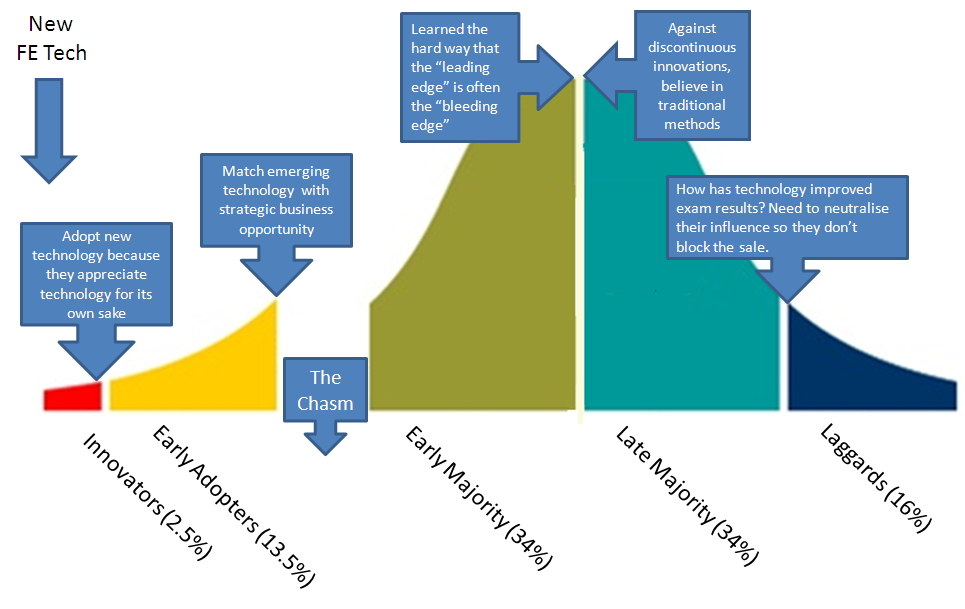
Let's make sure that we can identify the 16% early adopters and have leaders that will help establish a culture that where we build bridges to help others so they can "cross the chasm."
I want the leaders who I believe are capable of taking everyone with them that they have my full support (for whatever that may be worth! Lol.) I will assist in any way I can for as long as I work in FE. However, I realise the irony of this offer given that I may need to do as Perce Blackborow did on Shackletons Expedition... and be a stowaway in order to get on board in the first place.
If you liked this post go out and get "Shackletons Way" and "Into Thin Air" both are great books about fantastic adventures.


 I attended Ed's presentation which impressed me from the outset, because his opening line to introduce EdMix was to made clear that this is a community of EdTech startups who support one another and share resources - not a Limited Company or PLC, or a quango filled with committees... a community of like-minded people who have an interest in Education and Technology.
 You know the kind of people... the "alpha male" "leaders" who are only in business to take what they can get for themselves - but come out with all the David Brent-type management speak about how "They always run with a team" but have no hesitation to cut their hard working "team mates" and employees when their poor leadership has put perfectly good projects at risk. My biggest lesson from these mistakes is that;