Wednesday, 16 April 2014

What Comes first the Culture... or the EdTech?

BillAuletCulture2
I read an article this week by Bill Aulet called "Culture Eats Strategy for Breakfast" where Aulet highlights that;

“Culture eats strategy for breakfast, technology for lunch, and products for dinner, and soon thereafter everything else too.” Why? Because company culture... guides employee decisions about both technical business decisions and how they interact with others. Good culture creates an internal coherence in actions taken by a very diverse group of employees. 

You get an idea of how important this is in Aulets' closing comments; 


"When I talk to entrepreneurs now, before I get too carried away with the idea, I want to probe them about their vision, mission and values. Ideas are cheap – and tasty too. Culture eats them even before its pre-breakfast morning run"

After reading this article I recalled the first time I met Bill Aulet. I attended an "Entrepreneurial Product Marketing" workshop ran by MIT in January 2011, thus began my journey into the future of engaging with educators. 

After reading this article I reflected how much I had learnt, how much of the course material that I could recall... and how far I had come in my professional development (for more details about this journey see One Small Click for a Digital Immigrant).

SensAble Due Diligence

It was also on this course that I discovered just how hard it is to get everything right when you're trying to create great technology! This was exemplified by studying the progress of an MIT startup called SensAble Technologies. I highlight the level of due diligence that the company went through to identify their initial target market in my EdTech report (See Page 33). 

The company wanted to find the best initial target market for them to focus all their energies on. They had identified 9 potential sectors and during the process of whittling this down to one niche area, the startup was looking to get answers to questions like;

1) Is the "target customer" well funded. Are they readily accessible to our sales force?
2) Do customers have a compelling reason to buy?
3) Can we deliver a "whole product" today to fulfil that reason to buy?
4) Is there no entrenched competition that could prevent us from getting a fair shot at this business?
5) If we win this segment, can we leverage it to enter additional sectors?
6) Can we show results in a one to two year time frame? 

Stop for a minute and compare this criteria with Education as a target market. In my experience, I have found that points 1 & 6 have been particularly troublesome... and I'm not alone. Indeed some serial entrepreneurs have even asked me "Why do you work in Education? Don't you know how tough EdTech is?"  

You don't ignore advice when it comes from people like this! But, at the same time, this is something I am passionate about and was reluctant to move on... So I decided to look at some of the reasons why "EdTech is tough." What I found was that products fail to live up to expectations for a number of reasons, but can usually be traced to having the wrong kind of culture in one way or another. Here are some of the things that I learned as a result of being on this workshop.

Poor Products... Poor Planning
The first question to ask is: how much "bad EdTech" is out there? I have asked a few educators "what percentage of EdTech products/services that they would you recommended to colleagues in other departments/colleges?" The answer? 20-30%.

With stats this low is it any wonder that there is skepticism when "the next big thing" in EdTech comes along? If I was an educator and would only recommend 30% of the technology I used, I sure would be wary! So what can be done, if anything?

I have found that more often than not, products that don't quite live up to expectation, comes down to poor planning... the company might not do as much due diligence in the early stages as it could have. In his book "Disciplined Entrepreneurship" Aulet asks startups to consider questions like;

Identifying with your customer
I was introduced to a number of great books on this course. One of these was Geoffrey Moore's classic Tech book "Crossing the Chasm". Moore suggests that startups who don't have any customers yet should build a profile of what their potential customers would look like. "Target-customer characterization" is a formal process of keeping the customer in mind when developing products and your strategy. Once you have this image in mind, you will be better able to use this as a guide to developing a truly responsive approach to their needs. 

1) What Job title do they have?
2) What course did they study?
3) What do they read?
4) What do they wear?
5) Where do they go?
6) What are their hobbies?
7) What is their career path?
8) Who influences them?
9) How do they view the world?

A Day in the Life of... 
Part of identifying the customer profile is to consider "A day in the life of..." the group you are trying to help. Moore provides some great proforma's including on how to paint a "before and after" picture of how much easier people's lives will be when using your product, as this is a great way of focusing the mind. This is also a good way of drawing out the benefits of your product, which is essential when your product/solution is nothing more than a vision... and a rough sketch on a napkin/whiteboard. 

Moore uses the example of an airline mechanic and how they would benefit from making the switch from paper copies of the aircraft's manual to ebooks, and the impact the new method would have i.e. More planes will get fixed quicker, thereby saving money and having happier customers.

"A day in the life of our customers" also helps to differentiate between a products features, functions and benefits

It can be surprising how often tech enthusiasts (and salespeople) can get the 3 mixed up. While it's great to consider a day in the life of your customer, there is also a challenge with new idea... Most people don't like change, we can be creatures of habit and like our routine. It's for this reason that some investors/entrepreneurs suggest that a new method/solution needs to be TEN TIMES BETTER than the existing way of doing things. Ouch! 

Reading the situation
After attending Bill Aulet's course I read most of the books on the "Recommended Reading" section of his website.

I have noticed a curious thing about some of these books... any time I have been to any UK based Tech or EdTech networking events and ask "Have you read Crossing the Chasm?" or other books that have had a big influence on me, there have been blank looks "No I haven't, what's it about?" In other EdTech circles I understand these books are on most people's bookshelves. I know they are at MIT... And maybe that has made all the difference. 
These books have been crucial, I don't know where I would be without them. If you read them and then look at any company that is experiencing rapid growth and/or are doing great work, you will start to see a trend... which is you end up thinking "They must have read the books the guys at MIT recommend."

This is part of the reason that I am such a big advocate for Steven Isaacs (@Mr_Isaacs) and Katya Hott (@Katyamuses) #EdTechBridge community, as it aims to bring together people with an interest in creating great EdTech to come together and share the things that they have found to work.This includes understanding what educators what and how they would like to be engaged with.

Sales Matters
Something that really surprised me about both Aulet and Moore's advice was their attitude and views on sales. In most companies one of the first roles that they fill is for sales people... after all "Nothing moves in here until someone sells something" right? 

But is this also the reason that sales has the highest levels of staff turnover in startups? Can good sales people get blamed for poor uptake, when the root cause is actually a product that has some flaws? (See Pages 37 & 42).

Compare this with the discipline and focus that MIT recommends. SensAble Technologies did not employ any sales people until AFTER they had identified that their focus would be on the CAD industry. Then they employed people who were already working in the sector, who were known and trusted within the industry.

So much changed after I attended this course. I learned all I could about Inbound Marketing, especially as I realised that my sales experience was rapidly becoming out-dated, obsolete... and unwelcome. I needed to re-skill! And fast!
I discovered early on in my exploration with Inbound Marketing that this was time well spent. I received an email saying something along the lines of;

"Please can I unsubscribe from your corporate emails, but keep me updated with the stuff you send via LinkedIn and social media" 

Unfortunately my boss at the time "Didn't get" any of this work and insisted that I continue with the cold calling. 

But I continually see the benefits of taking the time to attempt to re-skill with content marketing, and this week is no different;
  • Watch "The Call Center" for 5 minutes and you get a sense of how people feel about cold calls
  • Content Marketing is attracting more and more interest from various groups
  • I have had a number of people who can only be described as "Influencers" in education engage with me
  • Some of these people recalled and praised me for some of my ramblings in my reports and blogs, even content that I had produced 2 years ago. 
It's for all the reasons above that I believe that a team with the right culture but the wrong product is better than a team with a great product but the wrong culture. 

Tonight #EdTechBridge will be discussing "Strategies for nurturing relationships between Educators and EdTech Developers & Entrepreneurs" and I will be very surprised if the advice for educators is not mirrored in the advice that MIT would offer.

So if you're in EdTech and have not already read some of these books, then go check them out: Bill Aulet: Recommended Reading

Friday, 11 April 2014

#Bettergrade Relationships - Sending a Clear ClassDojo Message

#EdTechBridge had its second chat session this week and moderator Steve Isaacs highlighted some of the publicity and impact that this new Twitter EdChat was receiving. My participation within this community saw my efforts being acknowledged publicly, which I am extremely grateful for, but can tend to feel a little uncomfortable with. 

That said, there is one idea that I have been praised for that I would like to focus on. I have mentioned the impact that Adam Grant's book "Give and Take" has had on me in previous posts, as well as the ways in that experienced Community Manager's have helped me via forums like #cmgrhangout and #Cmgrchat. A core message from Grant and Community Managers is engagement and collaboration, and has inspired me to look for ways of doing "5 minute Favours" for people. This is where you do something that would only take you a moment to do...but could have a big impact on the recipient. Here's Adam Grant explaining how this works;

How can I help - The 5 minute Favour


I spent 5 minutes helping a few people this week and the impact of this could have the potential to be significant, here are two examples.

  • Scott Freschet mentioned the impact that me sending a quick Tweet had on him in his post 3 lessons learned from #EdTechBridge.

    The impact for Scott may mean that he gets to test his service in a new sector of education... but without the expense of employing a UK sales/marketing person to find some early customers. The impact on the educators is that they could have a new service that helps with functional skills with a company that want to collaborate and will value their feedback.

    Then there is the fact that, as Scott says in his post, he promises to "Pay it forward." As you can see in the Tweet above, he's making good on that commitment

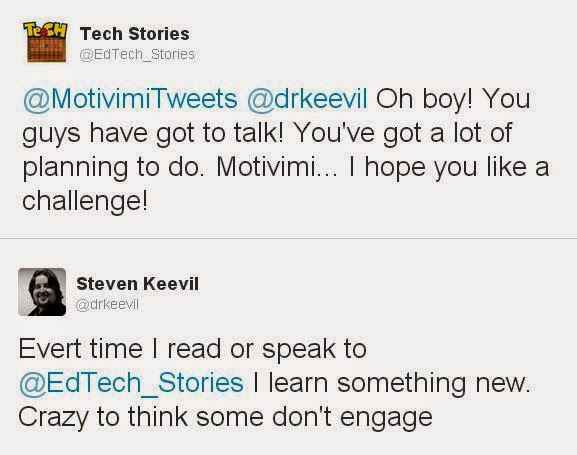
    Steven Keevil was someone that I asked if he'd check out Scott's service, because I knew he was involved in a new literacy project... and one where he's going to need all the help he can get!
  • I caught up with Steven this week to discuss an ambitious new project he's currently exploring, and will be spending 10 minutes to detail some case studies that should help with his presentation.

    The impact for Steven is that I might have helped find evidence to support how compelling the value proposition of his idea could be, evidence that he might be able to use to convince his employers. The impact on others is that Steven will be able to develop an idea that just might turn round the lives of some young people who have been written off.
The Basics of Power Networking - Adam Rifkin's Networks
Give and Take I have found that people can have a tendency to second guess the motivations around this kind of activity. But there is no need to second guess anything. The reasons are... because it makes perfect sense;

Paying it Forward - There are people who have helped me in the way that I try to help others, like the Community Managers who have been kind enough to provide the benefit of their experiences. I hope these Community Manager feel that I have not take up too much of their time... but their advice sure has had a big impact on me!


I thanked some of these Community Managers this week for their input, and asked how I can repay them. Their reply was... "all I ask is that you pass the favour on," I assured them I would

Culture - I am involved with a number of communities at the moment, all at different stages and with me playing different roles. One of these communities could do with a slight change in culture, a bit more give and take... more engagement & collaboration. I am also involved with some new communities, both online and in real life. 

Some of these groups consist of diverse members who, while they have the same goals they can have different priorities, agendas and perceptions. Regardless of whether you're trying to shape or change the culture, you need to lead by example. By the way, this article is worth a read "What culture IS and IS NOT"
"Examine Culture as the Foundation to Community" Yammer Community Playbook
Relationships - The culture that is established dictates the kind of relationships that members of a group or community will have. The relationships that I want to have are positive, constructive, engaging and collaborative. After all, it's through these kind of working practices that great EdTech comes from.
Who do you want to work with? A question that was asked during #EdTechBridge was "What kind of EdTech would educators and EdTech companies want to work with?" For me it's EdTech that spreads by educators through word of mouth referals. Here are some of my faviourite articles on this topic;

How Good Ideas in EdTech Go Viral How this Startup won over Oregon EdTech Startups with big impact tend to be rather simple

The chat also asked what would this collaboration would look like?


Positive Messages - How can I help?

Two years ago I set myself the goal of developing my inbound marketing skillsset in the hope that EdTech who enjoy this kind of viral roll out might consider working with me. Two companies that are high my list to collaborate with would be ClassDojo and CrowdMark, because they seem to get universal praise from educators.

Just before this weeks' #EdTechBridge session I sent a Tweet to James Collander at Crowdmark to ask if James would be joining the chat. He wasn't able to attend, but the Tweet did lead to an invite by him... followed by the offer of a 5min favour. What will come of it? Who knows? But, if I spend a few moments sending people in my PLN information about Crowdmark, what's the worst that could happen? Some of my contacts get introduced to some great EdTech, that can save them some time?

With ClassDojo not only do they get praised by educators but their founders, Sam Chaudhary and Liam Don, are on Forbes list of the top "30 Under 30" in education.  

I watched a video about ClassDojo new messaging service and I could see this being really useful in FE. However, I believe that ClassDojo's customer base is predominantly US primary schools.


Therefore, I am going to take a moment to highlight how and why I think ClassDojo could be beneficial in post-16 education in the UK. If both ClassDojo and FE like these ideas then ClassDojo will have a new market, FE improved student behaviour and my personal goals could become more tangible, all of which will have been the result of a "5 minute favour," talk about win-win-win situations! 
In addition, this activity will also mean that I will be;

1) Repaying a debt of a kindness that others have done for me 

2) Creating the right culture, which will result in...
3) Building some new relationships in the right way, through collaboration and positive engagement

I hope you can see the benefit to everyone involved with the concept of the 5 minute faviour, and that you might give it a try yourself. I also hope that this post will help you realise that any time I say "How can I help?" that you know I mean it, and that you'll take me up on the offer.

Tuesday, 8 April 2014

A Virtual Reality... Or Pie in the Sky Myths?

70+ Participants, approx 450 Tweets, a good mix of people, a meeting of minds, lots of enthusiasm from educators and entrepreneurs to connect and collaborate... Absolutely fantastic! Those were my "takeaways" after the first #EdTechBridge session.

It was disappointing that a few 
UK Further Education Chat #ukfechat regulars missed the session due to the UK/US time difference, an issue that the moderators have now resolved. With regard to FE, people in my PLN may have been tucked up in bed, but we still succeeded in building bridges all the way across the Atlantic...and across EdChats. We were able to introduce former LaunchEdu finalist, Scott Freschet, and his company Activity Learn to some FE people who I knew had an active interest in Functional Skills. 

Scott and I actually connected prior to the chat as we swapped blog posts on how important we both felt getting feedback from educators is here's How Activity Learn Incorporate Educator FeedbackToday I was made aware of two blog posts regarding what a positive experience participants found that #EdTechBridge. Here is Scott's take on the event with the 3 lessons he learned from #EdTechBridge, and chat moderator, Steve Isaacs review of the premier: #EdTechBridge - What an Opening Night

Both posts mention my involvement with the session and I would like to thank both Scott and Steve for their kind words. I really appreciate it. I know this was only the first session and, as Jerry Blumengarten Tweeted:

This is just the beginning and it may even take a bit of work to "keep it together" but
 what a start! The spirit of collaboration really was fantastic. 


I wanted to follow Steve and Scott's example and write a post about how great an experience this session was because I had an absolute blast...But soon found myself come down from this EdTech cloud 9, and down with a bump too! I was reminded of the area of education that I work in. I wonder what advice people would have if this area of education didn't appear to have beginning. What if people refuse to come together? Or worse, if they thought they did but actually didn't? What do you do then? 

False Start...
My good friend and #ukfechat moderator Sarah Simons posted an article called "Virtual Reality" which is a critical look at EdTech. Her parting comment in the post is; 

"I will take the evangelistic materials and pop them on a pile marked “I don’t think so”

Not only do I have to contend with the fact that there has been little by way of progress, I also have to deal with what appears to be a difference of opinion with someone I get on well with. If we have opposing views... What to do? Ignore the comments in the article? But I've spent a year doing what I can to try to shift peoples' views in FE regarding EdTech, so feel compelled to say something. This is especially true as the advice I gave when introducing Scott to people in my PLN was;


Playing Devils Advocate
Neither do I want to have a tit-for-tat argument in public, but want to respond and address some of the points raised... I know what I'll do, I'll follow Steve Isaacs lead. I agree entirely with Steve's point that it is important to have a private forum to allow the detractors voice to be heard.

It is important to give voice to the dissenter. In group situations, the presence of a blocker can actually make the decision making process more rational and less likely to go off the tracks. It gives us a new appreciation for someone who tends to play “devils advocate.”  Although no one is likely to win a popularity contest by playing the devil’s advocate, businesses would do well to respect a dissenting opinion – if not straight out encourage someone to take on such a role. The dissenter, of course, is as likely to be wrong as anybody else, but the discussion of the points made by the dissenter can add perspective to the debate.


There is a great army example which is designed to question qroupthink is an individual believes that the group is wrong see the Getting off the bus to Abilene section of this article.

Convincing the Skeptics
I agree that these voices can sometimes be missing in EdTech discussions, but I am careful to make sure that I seek them out and listen to their concerns. Any time I am looking at a new service that looks promising, I ask the detractors of technology within my PLN to help me find all the reasons why this EdTech might not work, this is extremely important because I am 100% aware that;


I think that I convey the importance of the establishing relationships with detractors in my EdTech report Developing Relationships and Delivering Value and the fact that there is an entire section on Convincing the Skeptics (See section 8 on Page 26). So my attitude towards this group has been well documented for over a year. This report also includes Geoffrey Moore's fantastic observation that I believe is one of the biggest stumbling blocks with EdTech;

"Sales & marketing departments must refocus away from selling products and toward creating relationships. Partnering with customers is a key component. The primary challenge here is not technical, but cultural" 

Virtual Reality
But Sarah knows all this... indeed she even provided a comment for me to include in the report. But how to reply? I'll try this...

Firstly please allow me to say... thank you! Thank you for being brave enough to put your points across, even though you might have guessed that they had the potential to court controversy, not to mention the backlash from the tech enthusiasts. It can't be easy airing the a detractors' views in this pro-EdTech Further Education Learning Technology Action Group (FELTAG) era. It is my belief that EdTech needs more of this kind of discussion. 

User Vs Developer Mis-Match
At the core of Sarah's argument is something that is common in EdTech development. Developers are obviously proficient with Tech (well maybe not all, but most are. Lol), so can tend to make assumptions about users' ability and their level of tech proficiency. I made this point when I produced "Tech Story - What Education can Learn from Pixar's Toy Story" with Chris Grant in 2010.

User Error – “My Arms are too short!!” 
"Another consideration is how proficient the users will be with Tech Toys. When trying to defeat Zurg in a computer game Rex turns to Buzz and complains in frustration that he’ll “never be able to defeat Zurg because of his little arms”, because he can’t press the fire button and jump at the same time. 

This Tech Toy doesn’t suit Rex so he can’t complete the game without assistance. Buzz and the other Toys may be happy to offer assistance initially, but if help is required on an on-going basis then everyone may become frustrated, so Rex may decide not to use that Tech Toy anymore. He may decide to play with older, more familiar toys instead." Tech Story 
So I can see how the same is true with access to the internet and other devices... but this is not restricted to developers! Accentuated perhaps, but they are by no means alone. Indeed we spent a while with no internet connection at home and on many occasions my kids were given homework that involved wed-based activities. Given that our local library closed as a result of budget cuts. This did pose some challenges, especially when you factor in after school activities and library closing times. So which group was wrong with their assumptions on access to technology on this occasion? The educator or the EdTech guy?

This random example aside, I agree with the point that developers have a different level of proficiency and understanding of how disconnected FE students can be at home and, to the shame of policy makers, how unplugged FE Colleges can be. 

The Harsh Truth
Now for the thorny issue of the harsh truth and the myths around this reality that Sarah reports on, which is less virtual and more non-existent! I have some very different experiences, opinions and evidence as to exactly how and why there is; 

"A horrifying lack of awareness about the reality of resources within colleges" 

And it has nothing to do with the "tech-botherers" and an awful lot to do with colleges who, it would appear, simply can't be bothered!

Can't be Bothered
I know that Technology in education is no "cure all," neither do I constantly bang on about how great technology is or any magic powers to hypnotise students to learn or make colleges "outstanding". I did a quick scan of my previous tech-based posts and, from what I could see, I had more posts designed to encourage detractors and calls for collaboration, than I had written about the "Outstanding EdTech promised land".

In fact, as someone who knows that education does not operate in silos, I do my best to produce content with a holistic outlook, so a lot of issues I talk about are not tech related at all (Whether the content is any good or not is another matter).

Please allow me to put forward some evidence in an attempt to counter this claim with the fact that there is;

"A horrifying lack of engagement within FE for people who are trying to do good work with colleges"

Please note: There are links to a number of previous blog posts below. Obviously people are welcome to read that might appeal, but the intention here is more to put my argument forward as opposed to people reading them all. That said, if you have the time and find them engaging, by my guest ;)

Non Technology Examples
  • Hardly a single idea from my Culture in FE report involves the use of Technology, instead there are case studies highlighting the power of positive messages, psychology research and organisational culture examples. 

    Indeed it might be argued that the majority of my EdTech report has very little to do with Technology as it focuses on culture too! Organisational culture plays a big part of my blog posts and reports.

    While the ideas are not technology based take a look at I get the material from. I have an interest in developing great EdTech, so read about operational practices of Google, Apple, Amazon etc. But instead of simply taking these ideas and applying them to tech, I also try to apply the principles to FE. Please allow me to submit
     Exhibit A: Culture in FE Report

    Supporting evidence with blogs about organisational culture internal/external, students and technology can be found at the end of this post
  • It's not just culture that I have tried to transfer the ideas of Google, Apple, Microsoft et al to FE. When the recession was starting to bite I produced report with 9 potential income generating ideas for colleges. To help ground these ideas in education I tried to "mash up" 1930's Stanford Professor, Fred Terman's example, along with my own humble experiences with the changes in the sales process.

    Here is Exhibit BBusiness Development Ideas for FEThese ideas are still sitting waiting to be developed, and you may have noticed that Frugl was in the press this week... looks a bit like one of these ideas don't you think #missedopportunity!
  • I know the importance of listening to the FE Community... which is why I have attended #ukfechat every Thursday night at 9pm for the last 14 months. 

    Furthermore as a regular participant I try to add value to the discussion. During one such session I put forward the idea of
     Exhibit C & D#ukfechatrq research project. I then submitted a number of ideas that I felt might be worth exploring. 

    As irony would have it, I actually detailed these ideas in my "
    Good Roll out processes come to those who wait..." post, and explain the reasons why I come up with all kinds of ideas but don't run with them, because the ability to reach customers is challenging and needs addressed. 
In order for Tech to avoid Sarah's "I don't think so pile" two things are needed. Any time I have been "cult-like" on the issue of EdTech it has been to "bang on about," be advocate of and, in a couple of cases, exasperatedly plead for it is the same things Sarah feels EdTech is lacking: Engaging and collaborating with the sector

I don't mean to be critical, so I won't be... but I will be honest. It is my belief that more was achieved on the other side of the the Atlantic with EdTechBridge in one night to shift perceptions than what I've managed to achieve by working on this for 1-2 years in FE. I will leave you with all the evidence you might need to demonstrate this.
 Exhibit C: Asking for Input.

I have included 2 examples below but at the end of this post there are a further 17 posts that provide further evidence of the engagement and collaboration I have tried to get... with varying, but mostly disappointing, results; 

EdTech Products: Best Practice Survey
12 months ago I circulated this link to people, how many responses to date? 2! Who from? From connections in the US. Not a single FE reply.

·     Supporting FE - Conferences, College Sponsorship & Commercial Services 12 months ago I circulated this link to people, how many responses to date? Not a single reply.

Myth Busting in EdTech - An Invitation
I started this post focusing on the positives of EdTechBridge and I sure don't want this post to end in the different stakeholders taking sides and entering into any tit-for-tat exchanges. I have put my argument forward... and that's direction I want to focus on - forward. 

I am less interested in what past problems are and more interested in finding solutions, and I know what the solutions are, because I have a very topical example.

I would encourage anyone reading this to check out these 2 posts to see what happens to an idea when the EdTech entrepreneurs try to "go it alone" Vs getting input with educators;

#StartupEduChat Meets #EdTechBridge - Nice idea, bad presentation! 
Life's a Pitch - Presenting Ideas in Edu - The joys of EdTech collaboration with Educators!

On Wednesday at 11pm GMT/6pm EST a bunch of EdTech'ers who what the same thing as educators, whether proponents or detractor of EdTech, will be getting together in the hope of learning from educators. The topic will be to bust some myths about Educators and EdTech - maybe Sarah and any others in the FE "detractor camp" would like to join the debate and let us know how we can improve on our current methods of EdTech development, engagement and collaboration.

More Myth Busting Evidence 
Please find a selection of other Tech and non-Tech posts that this Startup EdTech guy wants to engage and collaborate - Here's the the Tech based posts with a brief outline of the topic;

EdTechBridge Related Posts
Community Building in Edu & FE... Building EdTechBridges Was just about ready to quit education... what stopped me? Hanging with a new crowd.
From Nightmare Scenario... To Living the Dream?
After a year of hard work... are things about to come together?
The Greenwich Village of EdTech
Can we create an online Global Greenwich Village for EdTech?
EdTech Startups & Beta EdChats - Lone Nuts or Visionaries?
Are Steve Isaacs and Katya Hott ahead of their time... or just plain crazy? I'm taking bets DM for details on the latest odds. 
Helpful, Friendly and Upbeat Posts
Sales People in Edu - The Fox of EdTech?
Business plan that took 12 months to develop all made readily available online for all to see... the Reason? Explained in the post.

100% College Roll Out
An impossible New Year resolution? Motivation for wanting to work with all FE Colleges? The reason might surprise you, given it's from one of those profit making EdTech people.

The Reluctant Entreprenuer
Details as an ambivalent relationship to startups and EdTech, and the kind of dissent that would do a technophobe proud.

Collaboration in Edu: How can we Help Achieve your Goals?
You'd be surprised at the reaction you get if you send an e-mail saying "Can I help..."
Exaspirated and Fed Up Posts
Disconnected, Disengaged...Or Dispossessed? 
Why am I getting so much interest in the US, but not in the UK! Give me a clue... I've tried everything, and I'm fed up!
Where in #FE is Everyone? 
Statistical evidence of just how fragmented FE is using Twitter data

(Reasonably) Pro Tech Posts
Massively Creatively Disrupt... Or Someone Else Will!
Not so much pro-Tech, but an apoplectic warning that Starbuck might steal educators lunch. Ridiculous I know! It'll never happen will it? But wait...Isn't that what the music industry said about digital downloads?
What does the US do that the UK doesn't?
Was Henry Ford a Connected Educator?
Social Media... waste of time? Or time saver?

Posts For Detractors
Startup Education The same discussion 12 months ago as we're having today... Humph!
Change can be Scary... But AWESOME
Love Lego? Hate change? Read this!
Feltag Friday! Is it Rocket Boosters on? ...Or Huston We have a Problem! 
Got praised by proponents and detractors alike with this one. 
Expedition FELTAG - The Cloud would be an Awfully Big Adventure 
7 Lessons that educators could learn from Shackleton. 
One Small Click for a Digital Immigrant… A Giant Leap into a New Online Universe?
Did you know... I used to be in the "why would I care what you had for breakfast" camp too. Here's a summary of my bumpy journey

BaaZynga! Getting an Education in the field 
Its the Te@ch... Not the Tech that matters. Warning: This is post is bizarre! But does make a similar point to what Virtual reality makes
Social Media in Education Risk Report
Am a big fan of social media but we need to know the risk
Additional Culture posts
Internal Culture

External Culture